The Role of Thermal Consultancy in Plant Efficiency Upgrades


The stills cannot hold rate and nobody has mapped which cooler is the bottleneck. Consultancy starts with the duty sheet, not a new plate pack. We walk the plant before we quote a unit.
Operations throttled flow to keep dP inside the pump curve. That hid the weep from the morning meeting and parked the problem on the plate pack. Heat transfer optimisation is not a new gasket set and a hope that the next clean restores nameplate. It is a decision about whether the duty, the fouling and the circuit still match the iron in the frame.
We design, manufacture and maintain industrial heat exchangers, plate, shell and tube, oil coolers, air-cooled units and cooling towers, and we see the same pattern on units that have been opened, cleaned and boxed up for years without anyone re-running the thermal. Industrial thermal consultancy exists to put numbers on that gap before the next shutdown window is spent on the wrong work.
When a Gasket Failure Is a Duty Problem
A blown gasket is a site condition. It is also a thermal signal.
Port erosion, over-torque, the wrong elastomer for the CIP chemistry, or a plate pack that has been restacked with mixed plates will all open a leak. So will a duty that has crept: higher inlet temperature, dirtier water, a cooling tower that no longer rejects the load, an oil cooler that was never re-rated after the compressor change
If the only action after the leak is a gasket kit and a return to service, the next CIP will look the same. The plant engineer who treats the gasket as the whole story will keep buying time and losing approach. Oil coolers on the same plant still follow the same as-found log.
We start from the leak, the CIP log and the live dP, not from a catalogue swap. That is the difference between a repair and an efficiency upgrade Cooling towers on the same circuit change the water chemistry the pack has to live with.
What Industrial Thermal Consultancy Actually Measures
Industrial thermal consultancy is not a walk-around with a thermal camera and a report that says the unit is hot. It is a re-rate of the live duty against the original design, the current fouling, the available pumping power and the rest of the circuit Fans and pumps
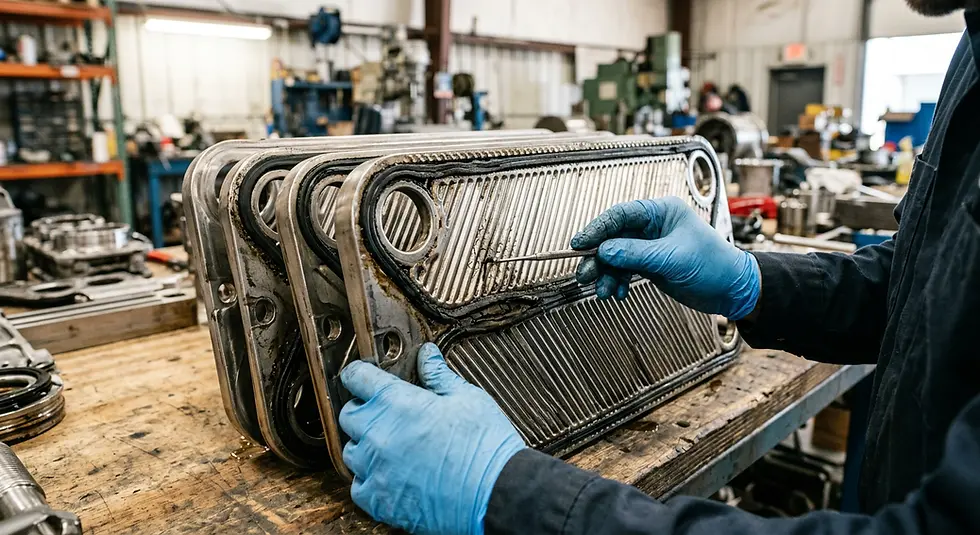
On a plate heat exchanger that means plate geometry, channel velocity, gasket material, port size and how the pack has been restacked after previous cleans. On shell and tube it means baffle condition, tube-side velocity, shell-side bypass and whether the bundle still matches the process fluid. On an oil cooler or an air-cooled unit it means face velocity, fin condition and whether the process flow was ever what the nameplate assumed.
The output is a decision: clean and return, restack, change plate or tube specification, add area, change the cooling water circuit, or stop spending shutdown hours on a unit that cannot meet the load even when it is clean.
That work is thermal consultancy when the plant engineer needs a defensible path before the next outage, not a quote for another gasket set.
Fouling, Approach and DP on the Live Unit
Three numbers tell us whether the unit is still the constraint.
Approach is the gap between the cold-side outlet and the hot-side inlet, or the equivalent for the duty as written. When approach opens up, either the area is no longer doing the work, the fouling factor has moved, or the utility side cannot reject heat. Guessing which of those three is in play is how plants spend a shutdown on CIP and come back with the same approach.
DP Is the Second Number a Rising
dP is the second number. A rising dP on the dirty side with a stable clean-side dP is fouling. A rising dP on both sides after a restack is often a packing or plate-mix problem. A dP that was always high is a selection or a pump-curve problem that no CIP will fix.
Fouling factor is the third. It is not a lab curiosity. It is the allowance that was built into the original thermal, and it is the first thing that dies when the water chemistry, the process fluid or the CIP interval changes. Heat transfer optimisation starts by putting a real fouling factor on the live unit, not the one in the original datasheet.
We want those three numbers from the historian, the local gauges and the last CIP, not from memory.
Plate Pack, Shell and Tube or a Different Exchanger
The next useful decision is whether the existing exchanger type is still the right one for the duty.
A plate pack that has been CIP’d until the plates are thin, the gaskets are mixed and the frame is at the last bolt hole is not waiting for a better clean. It is waiting for a thermal that says whether more plates in the same frame, a different chevron, a different plate material, or a move to shell and tube will actually close the approach.
Shell and Tube That Has Been Retubed
A shell and tube that has been retubed on the same pitch for twenty years can still be the wrong geometry for a duty that now fouls faster or needs a different velocity. An oil cooler that was sized on a clean ISO viscosity will not hold temperature once the oil has aged and the cooler has a film on the tubes.
We manufacture plate heat exchangers, shell and tube, oil coolers and air-cooled units, so the recommendation is not “buy what we happen to have in the workshop”. It is which geometry survives the fouling and the CIP chemistry you actually run.
If the constraint is not the exchanger at all, if it is the cooling water temperature, the tower, or the pump, changing the pack is wasted iron Allied Heat Transfer
Oil Coolers and Air-Cooled Units in the Same Circuit
Plant efficiency upgrades fail when the plate pack is treated as the whole plant.
An oil cooler that cannot hold lube temperature will take a compressor or a gearbox off-line regardless of how well the process exchanger looks on paper. Air-cooled units that have lost fins, taken a bird-screen full of lint, or been recirc’d by a wall that was not there at design will push heat back into the loop and make every downstream exchanger look dirty industrial thermal consultancy services. thermal consultancy perth
We look at the circuit, not the single nameplate. Process inlet and outlet, utility inlet and outlet, oil temperature, ambient, fan amps, and whether the cooling tower basin is actually at the temperature the original thermal assumed.
If the oil cooler is the constraint, the upgrade is on that unit and its airflow or water side. If the air-cooled unit is recirc’ing, no amount of plate-pack work on the process exchanger will restore plant efficiency
Cooling Tower Fill and the Water Side
Tower fill that is collapsed, scaled or bypassing is a utility problem that shows up as
We do not open a cooling-tower piece on a plate gasket, and we do not treat fill replacement as a separate conversation from the exchangers it serves. Cold-water temperature into the plate pack or the shell and tube is the utility the original thermal was written on. If the tower cannot make that temperature on the design wet bulb, the exchangers are being asked to do work they were never given area for
Fan pitch, fill condition, basin level, drift, and the chemistry that is supposed to keep the fill and the exchanger water side clean belong in the same scope as the plate pack. A cooling systems analysis and upgrade
Seawater duty makes this sharper. Cupro-nickel and titanium, velocity limits, chlorination, and the fouling that survives CIP are not optional extras. They are the difference between a unit that holds an approach and a unit that is opened every outage for the same scale.
Shutdown Windows, CIP and the Data We Need First
The shutdown window is already too short. Spending it on a CIP that was never going to restore design is how the same unit comes back on the next list.
Before anyone isolates, we want: design datasheet and the last as-built, live flows and temperatures on both sides, dP on both sides, CIP chemistry and duration, gasket material and age, plate or tube material, and what changed in the process or the utility since the unit was last in design condition. Photos of the last plate pack or bundle help. So does an honest note on whether the restack was done with mixed plates or a missing end plate.
If that data is not in the file, the first useful thing is not a crane. It is a logged run at a known load, with gauges that agree, long enough to see approach and dP settle. A single snapshot after a wash is not thermal.
CIP itself is part of the upgrade decision. If the chemistry etches the plates, swells the gaskets, or never reaches the fouled channels, more CIP is damaged. If the fouling is on the utility side and the CIP only ever runs on the process side, the clean is theatre.
Heat Transfer Optimisation That Lasts Past the Next Clean
Heat transfer optimization that only looks good on the day the plates come out of the wash bay is not an upgrade.
We rate the fouling you will have in six months, the CIP you will actually run, the water the tower will actually deliver, and the dP the pumps can live with. That can mean more area, a different plate pattern, a different tube layout, a change of gasket compound, a strainer or a filtration step upstream, or a cooling-water temperature that the tower is then required to make.
It can also mean leaving the exchanger alone and fixing the circuit. That is still industrial thermal consultancy. The plant engineer who only ever changes the unit in front of them will keep missing the constraint.
Australia-wide supply does not change the physics. A seawater unit in a coastal plant and a closed-loop oil cooler in a mill still fail the same way: duty drift, fouling, and a shutdown spent on the symptom.
Confined Space, Hot Work and Chemical CIP
Opening a plate pack or a bundle is plant work, not a paperwork exercise.
Plant energy use is why we measure the pack dirty and clean. Public work on industrial energy sits with CSIRO energy research. We plan the open-up around that evidence: deposit samples, plate condition, gasket set, and whether the leak path matches the thermal we ran.
A rushed open-up that throws the deposit, mixes the plates and loses the gasket map also throws the upgrade. The next restack then starts from a worse unknown.
Hot work on a shell and tube, lifting a pack, and chemical handling for CIP are scheduled as part of the outage, not as an afterthought once the unit is already open.
The Practical Next Step Before the Outage
Do not wait for the crane booking to decide what the unit is for.
This week, pull the design datasheet, the last CIP report, and a week of live approach and dP at a known load. Walk the cooling water from the tower basin to the exchanger and back. Note fill condition, strainer state, gasket leaks and whether the oil cooler or the air-cooled unit is running hot at the same time. Write down what changed in the process since the unit last held design.
Send that pack before anyone orders plates, tubes or a gasket set. We will tell you whether the next shutdown should be a clean, a restack, a different exchanger, or work on the tower and the circuit, and we will tell you if the unit is not the constraint at all.
Speak with us about the pack on that unit before the next shutdown.