Developing CIP Protocols for Industrial Plate Heat Exchangers

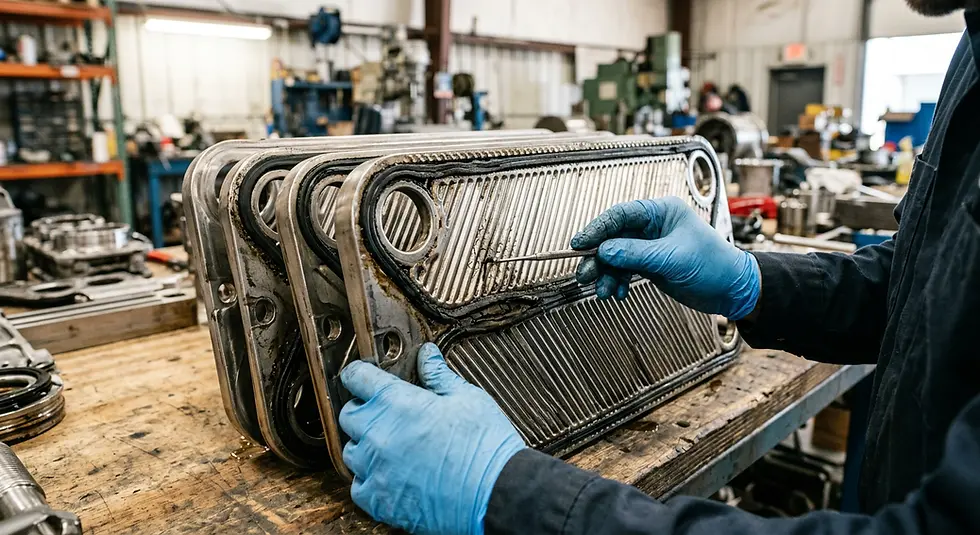
The CIP on that plate pack has been the same nitric circuit for three years, and scale is now bridging the corrugations on the hot side while dP sits well above the clean curve.
A protocol that once brought approach back in a shift now leaves the far channels dull and the gasket faces stained where solution never arrived. That is not a chemistry mystery. It is a procedure that was never rewritten against the duty, the alloy, the elastomer and the deposit that is actually on the plates.
Plate heat exchanger CIP protocols only work when they are written for this unit, this fouling, and the next operator who has to run the circuit without a specialist on the radio.
Start With the Deposit on the Plates
Do not write the CIP from the last work order. Write it from what is sitting in the channels.
Scale, biofilm, hydrocarbon film, product polymer and mixed deposits do not answer to the same drum. A white, hard bridge across the corrugations is not the same job as a brown, greasy film on the cold side. If the pack has not been opened in two years, the last photograph and the last gasket set are better evidence than memory Plate heat exchangers stay in the same work pack when the plates and gaskets are on duty. Shell and tube units are pulled on a different stand when the bundle has to come out.
Pull a coupon of deposit if the frame can come apart on a short outage. If it cannot, use the symptoms you already log: which side the dP rise lives on, whether approach moved first on the hot stream or the cold, whether the fouling tracks a cooling-tower fill change, a seawater season, or a process upset0 Air cooled heat exchangers
Industrial heat exchanger cleaning fails in the same place every time: the protocol treats “dirty” as one condition. It is not Oil coolers on the same plant that still follow the same as-found log.
Name the deposit in the procedure. If you cannot name it, the first line of the CIP is a sample, not an acid fill Industrial radiators
Capture Duty, Alloy and Gasket Before Chemistry
Before anyone cracks a drum, lock four facts on one sheet.
Plate alloy and thickness. Gasket compound and maximum continuous temperature. Channel gap and port arrangement. Clean-condition dP and approach for the current duty, not the nameplate from ten years ago. Cooling towers on the same circuit change the water chemistry the pack has to live with.
316 Behaves Differently to Titanium in Acid
316 behaves differently to titanium in acid. EPDM will take a caustic circuit that will swell an oil-soaked NBR. A wide-gap hygienic pack needs a different velocity target than a close-pitch industrial pack with a seawater duty on one side. Cooling systems around the exchanger are part of the same duty, not a separate guess.
If the gasket compound is unknown, stop. Guessing the elastomer from the colour of the ring is how CIP recipes destroy a plate pack that was only moderately fouled. Cut a remnant from the last change-out and identify it. Put the compound on the protocol header so the next shift cannot “improve” the mix.
Duty matters because CIP heat and flow come from the same nozzles the process uses. If the hot side is already near gasket limit in service, a “hotter is better” acid circuit will cook the elastomer while the scale is still sitting in the far channels. Fans and pumps on that circuit are logged with the exchanger, not after the fact.
Write the limits on the first page: max CIP temperature, max differential, which ports are suction and discharge, whether reverse flow is possible, and where the drain and vent actually are on this frame.
Select the Drum for the Fouling and the Elastomer
Chemistry is chosen for the deposit and then checked against plate and gasket. Not the other way around.
Mineral scale on stainless steel usually wants an acid circuit, nitric or an inhibited mineral acid, at a concentration and temperature the gasket can live with. Organic film, protein and many process residues want alkali first. Mixed fouling often needs a sequenced circuit: alkali to lift the film, rinse, then acid for the mineral that was underneath. Seawater and high-chloride duties on titanium are not a pickle job. Treat them as titanium.
The Drum on the Floor Is Not
The drum on the floor is not the specification. If the only bottle in the bund is last year’s nitric, and the plates are carrying hydrocarbon, that circuit will etch, not clean. Order the right product for the deposit. Put the product name, the concentration window, the inhibitor requirement and the compatibility note on the protocol. Leave the catalogue number out of it.
Never add a second drum because the first circuit “didn’t look like it was working” at the thirty-minute mark. pH and conductivity in the return, and dP across the pack, tell you more than the colour of the tank.
If the gasket is FKM and the duty is oily, caustic may be acceptable where NBR would not. If the gasket is EPDM and the duty is steam condensate with mineral scale, acid is usually the path, still inside the temperature printed on that gasket’s data. Write the incompatibility in bold. The operator who inherits this CIP at 02:00 should not have to remember a conversation from the last shutdown.
Set Velocity, Temperature and Contact Time
A plate pack does not clean because the tank is full of acid. It cleans because every channel sees flow, the deposit sees the right temperature, and the contact time is long enough for that chemistry at that concentration.
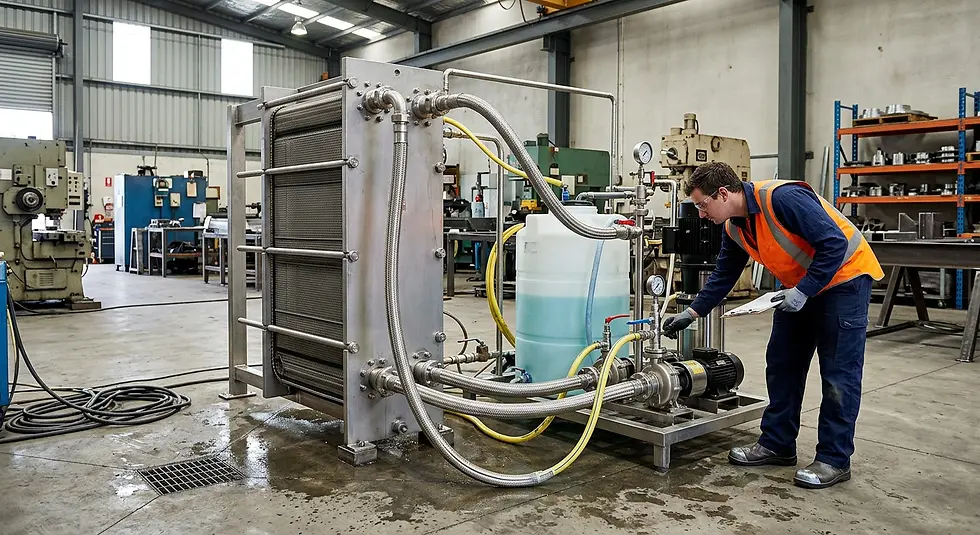
Channel velocity is the part most inherited procedures skip. If the CIP pump was sized for a different frame, the far channels starve, the near channels over-circulate, and you get a clean gasket groove with a blocked corrugation behind it. Check the pump curve against the clean dP of this pack. If you cannot reach a turbulent circuit through the plate pack, the protocol is a soak with a fancy name.
Reverse the Flow at Least Once If
Reverse the flow at least once if the porting allows it. Deposits that nucleate at the outlet of a hot channel will not see fresh solution if you only ever pump in the process direction.
Temperature is a limit, not a target to beat. Hold the circuit at the temperature the chemistry needs and the gasket permits. A slow ramp beats a thermal shock on a clamped pack. Record the skin temperature at the frame, not only the tank thermometer.
Contact time is decided by the deposit and by what the return chemistry is doing. A fixed four-hour flush is how you either under-clean a scaled pack or over-expose a gasket. Watch return pH or conductivity. When the return stops changing and dP has stopped falling, you are done with that step. Rinse until the return matches the spec you wrote, not until someone is bored.
Rinse is part of the protocol. Residual acid left in a carbon-steel nozzle or a downstream carbon-steel line is a new failure, not a clean pack. Specify rinse volume, rinse chemistry if you passivate, and the test that proves the residual is gone.
Prove Isolation Before the Acid Hits the Pack
CIP on an industrial plate heat exchanger is a live circuit on a process unit. Treat it like one Allied Heat Transfer
Blind or prove isolation on process inlets and outlets. Vent the pack so you are not compressing a gas pocket into the top channels. Confirm the CIP tank, hoses and pump are compatible with the drum you are about to dilute. Check the drain path so a dump does not land in a bund that cannot take that pH.
CIP Acids and Alkalis Are Industrial Chemicals
CIP acids and alkalis are industrial chemicals. Check the current introducer and inventory rules on AICIS before you specify a new clean chemistry. A plate pack CIP is not a workshop soak. It is a temporary chemical system tied into the plant.
Write the proof-out as steps, not as “isolate as required.” Name the valves. Name the vents. Name who signs that the circuit is made before the first litre of mixed solution leaves the tank.
Dilution is done in the CIP tank, not by hope in the hose. Add water first, then the product, then bring the temperature up. Putting concentrated acid on a dry stainless surface and then hoping the pump floods it is how you stripe plates.
Watch Gasket Faces and Plate Edges During the Circuit
The gasket is the reason a plate pack is a plate pack. CIP that cleans the metal and wrecks the elastomer is a failure you will pay for on the next start-up.
Stay inside the gasket’s continuous temperature. Avoid solvents that the compound cannot take. Do not use steam on a circuit that was written for a liquid clean unless the gasket and the frame design were rated for its plate heat exchanger CIP protocols.
Walk the frame during the circuit. Weeping at a gasket groove, a sudden drop in CIP pressure, or a sharp smell that was not there at the start means you stop, dump and inspect. Continuing because “we are already two hours in” is how a small leak becomes a plate-edge attack.
Keep the pack clamped at the dimension you use in service. A loose frame during CIP lets plates fret and lets the solution sit in the gasket groove instead of moving through the channel. An over-tightened frame during a hot circuit can take compression set out of an elastomer that was otherwise serviceable plate heat exchanger CIP protocols.
If the protocol includes a caustic step followed by an acid step, the rinse between them is not optional. Mixing those two in the pack gives you heat, salt and a gasket problem.
Stop CIP When the Pack Will Not Recover
dP and approach are the pass criteria. The visual colour of the CIP tank is not.
If dP has not moved after a completed, on-spec circuit, repeating the same drum at a higher concentration is not a protocol. It is a guess that attacks the plates. Stop. Record the residual chemistry, the final dP, the temperatures you actually ran, and whether reverse flow was used.
A pack that will not recover on CIP is telling you the channels are bridged, the deposit is no longer soluble in that chemistry, or the flow never reached the fouled zone. Another four hours will not fix a mechanical blockage.
Write the abort rule into the procedure so the night shift does not “give it one more cycle” until the gasket is cooked. Example: if dP has fallen less than the threshold you set after the timed circuit and a reverse, stop, rinse, and plan to open the frame.
That abort is the difference between industrial heat exchanger cleaning as a controlled job and a plate pack that comes apart as scrap.
Open the Frame When the Channels Stay Blocked
When CIP has done what a circuit can do and the pack is still dirty, the next useful step is an opened plate pack, not a stronger bottle.
Photograph the pack as the frame comes back. Note which end, which side, and which channels are bridged. That photograph becomes the evidence for the next protocol. If the fouling is only on the seawater side, the next CIP is written for that side’s chemistry and velocity, not for a generic “both sides acid.”
Once the plates are apart, stubborn mineral and process film is a job for chemical cleaning of the opened pack under controlled immersion, not another blind recirculation through a blocked channel. Plates that still carry baked deposits in the corrugation after a proper immersion then go to ultrasonic cleaning before any attempt to reuse the gasket set.
Do not mix those two decisions. CIP is for a pack that still flows. Immersion and ultrasonic work are for plates you can see. Putting an assembled, blocked pack back on a CIP pump because the shutdown window is tight is how you return to service with the same approach you had yesterday.
Inspect gasket grooves, porter holes and the first few plates at each end. Erosion, stress cracks at the hanger, and chloride attack on stainless steel show up there first. A CIP protocol cannot be signed as successful if the plates are thinning.
Regasket against the compound you identified, not against whatever ring is in the store's cage. If the duty has changed, hotter, oilier, more caustic, the gasket that lasted five years may be the wrong elastomer for the next five.
Log Approach, DP and Residual for the Next Protocol
The protocol you just ran is only useful if the next one can be better.
On return to service, log clean dP on each side, approach at the current duty, and the residual test you used to prove the rinse. If you passivated stainless, record that too. Keep a one-page CIP record with: product and concentration, temperatures, circuit times, reverse or not, abort or complete, and a note on what the return chemistry did.
That record is how plate heat exchanger CIP protocols stop being folklore. The next clean is written from the delta: if dP returned to the clean curve and approach held for three months, the chemistry and time were adequate. If the approach drifted in a fortnight, either the rinse left residue, the deposit was mixed and you only treated one fraction, or the process is throwing more fouling than this interval can take.
Trend dP weekly, not only at the clean. A slow climb after a “successful” CIP is often biofilm or a fine silt that the last circuit never saw. Shorten the interval or change the sequence. Do not wait for the same 22 kPa you started with.
If the unit shares a tower or a seawater intake with other exchangers, put the fill condition and the intake season on the same log. Fouling that arrives with a tower fill collapse or a seawater bloom is not a failure of the last acid step. It is a duty change the protocol has to absorb.
Put the Next CIP on the Shutdown Board Now
A protocol that exists only in someone’s head will not survive the next crew change.
Type it. One header block with alloy, gasket, clean dP, temperature limit and abort rule. Numbered steps for isolation, mix, circulate, reverse, rinse, residual test and return to service. A single line that says when to stop and open the frame. Attach the last photograph of the pack and the last gasket compound.
Hand that sheet to the person who will actually valve the circuit. Walk the vents and the CIP pump with them once, on the unit, not on a P&ID in the office.
Before the next shutdown or the next planned clean, do this one thing: pull the last three months of dP and approach, identify the gasket compound on that pack, and rewrite the CIP steps against the deposit you expect, not against the drum that happens to be in the bund. If the numbers say the circuit will not recover the pack, book the frame opening in the same window rather than discovering it
Speak with us about the pack on that unit before the next shutdown. That gets the pack apart before you make the fouling worse.