Expanding Thermal Capacity: When to Add Plates to Your Heat Exchanger


Scale from the last seawater duty has packed two channels solid. The CIP cycle ran its full time and the gaskets never leaked, yet approach only dropped half a degree and dP is still sitting 25 kPa above design.
That is the point plate heat exchanger capacity has been consumed. Adding heat exchanger plates is the next useful step, not another chemical wash.
We pull these packs in the workshop after the same story: process load crept up, cooling-tower fill started shedding, or the original fouling factor was eaten in the first two years. The frame still looks fine. The plates themselves are often still serviceable once you get the scale off. The area is simply no longer there.
You need to decide, on this unit, whether the existing frame will take extra plates or whether the whole exchanger has to grow.
When Approach and DP Tell You the Pack Is Undersized
Approach is the first number that moves. If the hot-side outlet is climbing toward the cold-side inlet, the pack no longer has the area it was designed with. A two-degree shift that CIP cannot reverse is usually fouling plus insufficient surface, not a pump problem. Plate heat exchangers stay in the same work pack when the plates and gaskets are the duty.
dP tells the other half. Channels that have narrowed from scale or debris raise pressure drop even when flow is unchanged. If the pump is already on the steep part of its curve, extra plates will restore area and also open more parallel paths, which often brings dP back inside the original envelope. Shell and tube units are pulled on a different stand when the bundle has to come out.
Log both numbers against the original datasheet before you order anything. Photograph the gauges on a typical production day, not during a weekend clean. We use those two readings, plus the current plate count, to calculate how many extra plates restore the duty without overshooting velocity on the remaining channels.
If approach is high but dP is still low, the issue may be maldistribution or a blocked port rather than missing area. Adding plates will not fix a blocked distributor.
Checking Gasket Condition Before You Open the Frame
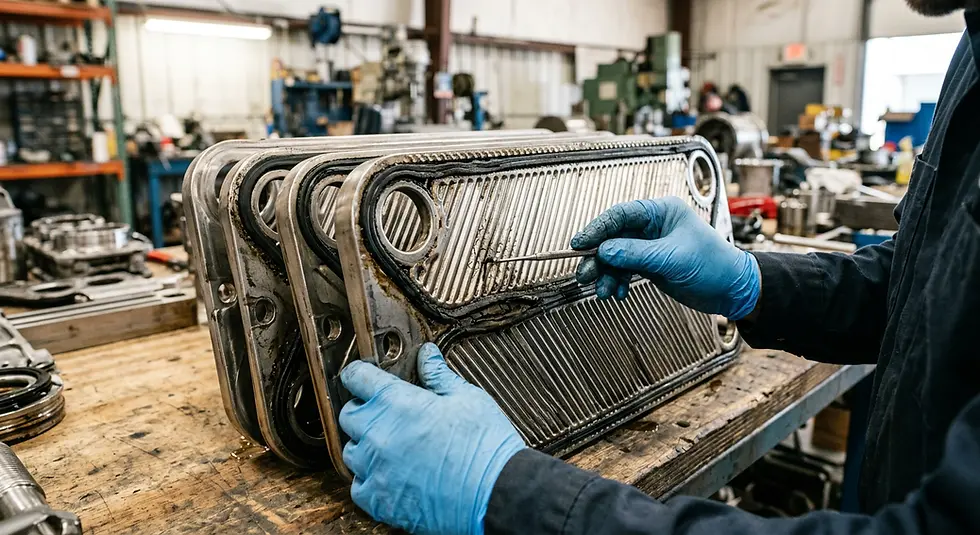
Gaskets that still hold after CIP are not automatically reusable when you expand the pack. The elastomer has already seen heat, chemicals and compression cycles. Extra plates mean the whole pack is compressed again, often to a new dimension Industrial radiators
Look at the gasket groove on the end plates and on a couple of intermediate plates you can see without a full strip. Cracking at the corners, flattening of the profile, or chemical swell means those gaskets should be replaced at the same time as the extra plates go in. Mixing old and new gaskets in one pack is the fastest way to a leak on start-up. Cooling towers on the same circuit changing the water chemistry the pack has to live with.
Clip or glue type, and the compound, must match the existing set. A different hardness or a different glue system will not seat evenly when the frame is tightened. We keep the original gasket specification against the serial number so the extra plates arrive already gasketed to the same standard. Cooling systems around the exchanger are part of the same duty, not a separate guess.
If the gaskets failed during the last CIP, do not add plates until the root cause is known. Over-compression, wrong torque sequence or a warped frame will only get worse with a longer pack.
Measuring Remaining Length on the Carrying Bar
The carrying bar and the tie bars set the hard limit. Count the existing plates, measure the compressed pack length, then measure the free length still available before the follower hits the last set of holes or the frame end.
A typical industrial plate is 0.5 mm to 0.6 mm thick plus two gasket thicknesses. That stack-up is not the same as the nameplate “plate pitch”. Use the actual compressed dimension from the last time the unit was closed, not a catalogue guess.
Leave a Small Margin Frames That Are
Leave a small margin. Frames that are tightened to the last millimetre become almost impossible to open again without damaging the carrying bar or the guide bar. We normally keep 20-30 mm of unused length so the next shutdown can still get a spanner on the nuts.
If the Last Hole on the Tie
If the last hole on the tie bar is already in use, stock heat exchangers are the faster route to a frame that still has growth left.
Photograph the carrying bar, the follower position and the remaining holes. Those three pictures, plus the original drawing, let us confirm whether extra plates will actually fit before anyone cuts metal.
Matching Chevron Angle and Plate Thickness
Extra plates must be the same pattern, the same thickness and the same port configuration as the plates already in the pack. A mixed chevron angle changes the flow path and can create dead zones that foul faster than the original channels.
Thickness matters for pressure. Thinner plates give more area per millimetre of frame length but they flex more under dP. If the original pack was 0.6 mm for a reason, do not drop to 0.5 mm just to squeeze in two extra plates.
End plates and the first few intermediate plates often have a different hanging arrangement or a different gasket cut-out. The extra plates that go into the middle of the pack must be the intermediate type, not copies of the end plates. We stamp and gasket them accordingly so the pack still hangs square on the carrying bar.
We run that next outage with Allied Heat Transfer against the duty already on the plant.
If the metallurgy is titanium or a high-alloy stainless because of the seawater duty, the extra plates have to be the same alloy. Mixing grades inside one pack sets up a galvanic cell the next time the CIP chemicals sit in the channels.
Extra Plates, Velocity and the Fouling Cycle
Adding heat exchanger plates increases area and, for the same total flow, reduces velocity in each channel. Lower velocity can slow erosion but it can also let particles settle. On a seawater or cooling-tower circuit that already scales, the extra plates must be balanced against the risk of a new fouling layer forming in the slower channels.
We calculate the new channel velocity after the extra plates are in. If it drops below the velocity that kept the original pack reasonably clean, the CIP interval may need to shorten, not lengthen.
Fouling factor in the original design is often the reason the pack looks undersized today. Extra plates can restore clean-duty performance, but they do not change the water chemistry. If the cooling-tower fill is still shedding or the seawater intake is still bringing sand, the new plates will foul on the same schedule unless the upstream problem is fixed.
Port velocity also changes. More plates mean more flow can pass for the same dP, but the ports stay the same size. Check that the nozzles and the connecting pipework can still handle the flow without a new
Isolation and Lockout Before the Pack Comes Apart
The unit has to be isolated, drained and depressurised before the follower moves. Residual pressure in a plate pack will spray the moment the first nut is cracked. Residual process fluid, especially after a seawater or chemical duty, is a slip and splash hazard plate heat exchanger capacity upgrade. It sits with Oil coolers.
Follow the plant isolation rules set out by Safe Work Australia before anyone puts a spanner on the frame. Lockout both sides, prove zero energy, and confirm the drain valves have actually emptied the channels.
Access around the unit matters. Extra plates mean the follower travels further. If the frame is hard against a wall or a pipe rack, the extra length may not be usable even if the tie bars have holes left.
We prefer to receive the whole pack in the workshop when the extra plates are more than a handful, because hanging and aligning twenty extra plates on site, on a live plant, is slow and easy to get wrong. If the shutdown window is short, the extra plates can be gasketed and numbered in advance so they drop straight into the existing hanging sequence.
Pressure Test and Leak Check on the Expanded Unit
Once the extra plates are in and the frame is tightened to the new dimension, the pack needs a pressure test before the process fluid goes back in. Hydrotest both sides, separately, to the original design pressure or the figure on the nameplate.
Leaks at This Stage Are Almost Always
Leaks at this stage are almost always gasket related: a twisted gasket, a damaged groove, or uneven tightening. The torque sequence on a longer pack is the same as the original, cross-tightening, not running down one side first, but the nut travel is greater, so it is easier to over-compress one corner.
We mark the new compressed length on the frame so the next person who opens it knows where it should close. A pack that is closed 5 mm shorter than design will crush gaskets; 5 mm longer and it will weep on start-up.
Start-up should be slow. Fill from the bottom, vent the high points, and watch approach and dP for the first hour. The extra plates will take a short time to wet out and to come to temperature. If dP is suddenly much lower than calculated, a plate may be hanging off the carrying bar or a gasket may have folded into a channel.
When the Ports or the Pumps Become the New Limit
Extra plates restore the area, but they do not enlarge the ports. If the original unit was already port-limited, adding plates will not give the extra thermal capacity you need. The flow will simply refuse to increase.
Check the nozzle size against the new duty. If the connecting pipework or the pumps cannot deliver more flow, the extra plates only help on the temperature side, not the flow side. In that case the next step is a larger unit, not a longer pack.
Pumps that were already close to run-out will not thank you for a sudden drop in dP. The system curve changes when the pack opens up. Confirm the pump still operates on a stable part of its curve after the extra plates are in, especially if the circuit also serves a cooling tower or another exchanger.
If the duty is going to keep growing, custom built products let the frame and the plate metallurgy be specified for the extra plates you will need later, with ports sized for the final flow rather than the original flow.
Calculating How Many Plates Restore the Original Duty
We start from the original heat-load, the current approach, and the current plate count. The extra area required is not a simple ratio because fouling has changed the effective U. A pack that has lost 20 % of its capacity does not always need 20 % more plates; the fouling layer itself has to be accounted for.
If the plates can be cleaned to near-original condition, the calculation is closer to the clean-duty rating. If CIP has stopped working and mechanical clean is the only option, we derate the extra plates as well. There is no point hanging twenty extra plates that will be fully scaled in three months.
Plate count must also stay even, or follow the original pass arrangement. An odd extra plate in a two-pass unit can leave one channel without a partner and create a maldistributed pass. We keep the hanging sequence identical to the original drawing, just longer.
Send the original datasheet, the current plate count, the two operating temperatures and the two dP readings. That is enough for us to say whether five plates, twelve plates or a new frame is the useful next move.
Planning Extra Plates Into the Next Shutdown Window
The practical next step, before the next shutdown or the next CIP, is to measure the free length on the carrying bar, count the plates that are actually in the pack, and photograph the gasket faces on the end plates. Those three pieces of information tell us whether adding heat exchanger plates is possible on this frame and how many will restore plate heat exchanger capacity without starving the channels of velocity.
If the numbers show the frame is already at its stop, the decision moves to a larger unit rather than a longer pack. If the numbers show there is room, the extra plates can be gasketed and numbered in the workshop so they go in during the same window you would have used for a clean.
Do the measurements on a running day, not after the unit has been drained and the pack has relaxed. The compressed length is the length that matters. Bring the original nameplate data or the last inspection report so the metallurgy and the gasket compound are not guessed.
Speak with us about the pack on that unit before the next shutdown.