
Materials Selection for Caustic Cleaning Environments

Updated: Aug 19
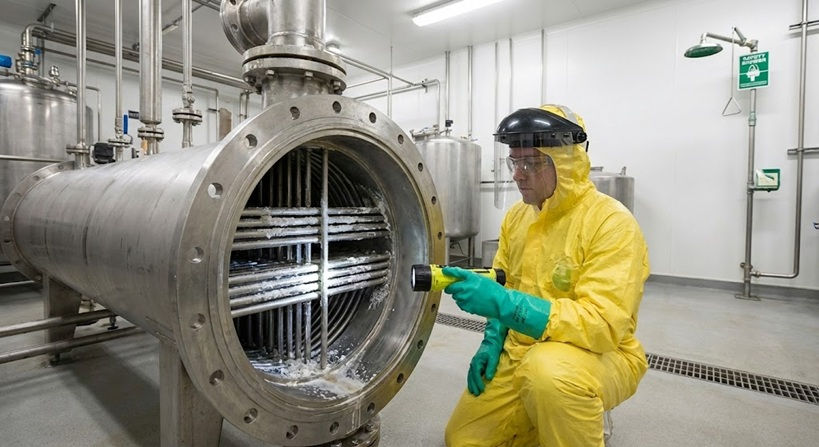
Caustic cleaning solutions destroy heat exchangers faster than almost any other industrial fluid. Sodium hydroxide (NaOH), potassium hydroxide (KOH), and other alkaline cleaners corrode standard materials within months, causing tube failures, shell perforation, and catastrophic leaks. Selecting the right materials prevents these failures and extends equipment life by decades.
Caustic environment material selection determines whether equipment lasts 2 years or 20 years in caustic service. Temperature, concentration, chloride content, and stress corrosion cracking susceptibility guide material choices from economical carbon steel through premium titanium and nickel alloys.
Understanding Caustic Corrosion Mechanisms
Caustic solutions attack metals through alkaline corrosion, a process fundamentally different from acid attack. High pH environments (above 12) break down protective oxide layers on carbon steel and many stainless steels, exposing bare metal to rapid dissolution.
Temperature accelerates caustic corrosion exponentially. A heat exchanger handling 5% sodium hydroxide at 40°C might survive 10 years, whilst the same concentration at 90°C fails within 18 months. Concentration matters equally - 20% NaOH solutions corrode 3-5 times faster than 5% solutions at identical temperatures.
Stress corrosion cracking (SCC) represents the most dangerous failure mode in caustic service. Even materials with good general corrosion resistance crack catastrophically under combined tensile stress and caustic exposure. Welds, tube-to-tubesheet joints, and high-stress areas fail without warning when designers ignore SCC risks during caustic environment material selection.
Carbon Steel: When It Works and When It Fails
Carbon steel resists dilute caustic solutions under specific conditions. Below 80°C and 10% concentration, carbon steel shell and tube heat exchangers provide economical service for 10-15 years with proper maintenance.
Temperature limits matter critically. Above 80°C, caustic corrosion accelerates regardless of concentration. Above 100°C, carbon steel fails within 2-3 years even in dilute solutions. Mining operations using carbon steel for caustic wash systems typically replace tubes every 5-7 years when operating below temperature thresholds.
Concentration boundaries determine carbon steel viability. At 50% NaOH concentration and 100°C, carbon steel actually performs acceptably because the solution approaches anhydrous conditions. Between 10-50% concentration, corrosion rates peak - this "danger zone" destroys carbon steel rapidly at any temperature.
Stress corrosion cracking eliminates carbon steel from many caustic applications. Even when general corrosion rates seem acceptable, SCC causes sudden tube failures near rolled joints and welded connections. Food processing plants report unexpected carbon steel failures after just 3-4 years when SCC develops.
Stainless Steel Performance in Caustic Service
Austenitic stainless steels (304, 316) resist caustic corrosion better than carbon steel, but concentration and temperature limits still apply. Type 316 stainless steel handles 10% NaOH up to 60°C effectively, providing 15-20 year service life in properly designed systems.
Chloride contamination transforms stainless steel performance. When caustic solutions contain even trace chlorides (above 100 ppm), pitting corrosion and SCC develop rapidly. Mining operations using bore water in caustic wash systems experience accelerated stainless steel failures due to chloride content.
Higher nickel grades improve caustic resistance significantly. Alloy 904L (20% nickel) and 254SMO (6% molybdenum) extend temperature limits to 100°C and concentration limits to 20% NaOH. Chemical processing facilities specify these grades when standard 316 stainless steel proves inadequate for caustic environment material selection requirements.
Stress relief requirements protect stainless steel from SCC. Heat treatment after welding reduces residual stresses that combine with caustic exposure to cause cracking. Allied Heat Transfer performs post-weld heat treatment on stainless steel pressure vessels when caustic environment material selection requires SCC protection.
Nickel Alloys: Premium Caustic Resistance
Nickel-based alloys provide superior caustic resistance across wide temperature and concentration ranges. Nickel 200 and Nickel 201 handle concentrated caustic solutions (up to 70% NaOH) at temperatures reaching 150°C, making them ideal for demanding chemical processing applications.
Monel 400 (67% nickel, 30% copper) resists both caustic and chloride environments simultaneously. Food processing plants specify Monel for plate heat exchangers handling caustic cleaning solutions with seawater rinse cycles, where chloride and alkaline exposure alternate.
Inconel 600 and Hastelloy C-276 extend caustic service to extreme conditions. These high-nickel alloys handle 50% NaOH at 200°C, temperatures where even Nickel 200 shows measurable corrosion. Petrochemical facilities use these materials when process requirements exceed standard nickel alloy capabilities.
Cost considerations make nickel alloys selective choices. Nickel 200 tubes cost 8-12 times more than carbon steel, whilst Hastelloy C-276 costs 15-20 times more. Engineers specify nickel alloys only when stainless steel cannot provide adequate service life or when failure consequences justify premium materials.
Titanium: Exceptional Caustic Resistance
Titanium resists caustic corrosion exceptionally across nearly all concentrations and temperatures. Grade 2 titanium handles 50% NaOH at 100°C indefinitely, providing 30+ year service life in applications where stainless steel fails within 5 years.
Temperature limits for titanium extend beyond most process requirements. Titanium maintains caustic resistance up to 200°C in concentrated solutions, making it suitable for high-temperature caustic evaporators and heat recovery systems. Chemical manufacturers specify titanium when process optimisation requires elevated temperatures.
Hydrogen embrittlement presents the primary titanium limitation. In concentrated caustic solutions above 150°C, titanium absorbs hydrogen, becoming brittle and prone to cracking. Proper heat treatment (annealing) and grade selection (Grade 12 instead of Grade 2) mitigate this risk in extreme applications.
Cost-benefit analysis often favours titanium for industrial cooling towers handling caustic drift and spray. Initial costs run 6-8 times higher than stainless steel, but 30-year service life versus 8-10 year stainless steel replacement cycles justify the investment.
Material Selection Decision Framework
Temperature represents the first caustic environment material selection criterion. Below 80°C, multiple materials provide adequate service. Above 100°C, material choices narrow significantly. Above 150°C, only premium nickel alloys and titanium survive long-term.
Concentration determines corrosion rates within temperature bands. Engineers plot operating conditions on caustic corrosion charts (isocorrosion diagrams) showing material performance across temperature-concentration combinations. These charts reveal whether proposed materials provide acceptable corrosion rates (typically below 0.5 mm/year).
Chloride content eliminates entire material families. When caustic solutions contain chlorides above 200 ppm, stainless steels become unsuitable regardless of caustic concentration. Nickel alloys or titanium become necessary despite higher costs.
Stress corrosion cracking susceptibility requires evaluation beyond general corrosion rates. Materials showing acceptable uniform corrosion may still crack catastrophically under tensile stress. Design codes require stress relief, material upgrades, or design modifications when SCC risks exist.
Design Considerations Beyond Material Selection
Velocity limits prevent erosion-corrosion in caustic service. Flow velocities above 2 m/s erode protective oxide films, accelerating corrosion rates by 3-5 times. Air cooled heat exchangers handling caustic vapours require careful fan sizing to prevent impingement erosion on tube bundles.
Crevice corrosion develops at gasket surfaces, tube-to-tubesheet joints, and baffle contact points. Proper gasket selection (PTFE or flexible graphite) and full-penetration tube rolling minimise crevice formation. Allied Heat Transfer uses hydraulic expansion for critical caustic applications, eliminating the tube-to-tubesheet crevice entirely.
Temperature cycling creates thermal stress that combines with caustic exposure to accelerate cracking. Heat exchangers experiencing frequent startups and shutdowns require stress-relieved construction or upgraded materials. Mining operations with batch caustic cleaning cycles report failures after 500-800 thermal cycles when stress relief is omitted.
Galvanic corrosion occurs when dissimilar metals contact in caustic solutions. Carbon steel shells with stainless steel tubes create galvanic couples that accelerate shell corrosion near tube penetrations. Caustic environment material selection must consider the entire system, not just wetted components.
Testing and Validation Methods
Corrosion coupon testing validates material selection before fabrication. Exposing material samples to actual process fluids at operating temperatures for 90-180 days reveals real-world corrosion rates. Weight loss measurements and metallographic examination confirm whether predicted performance matches actual behaviour.
Electrochemical testing accelerates corrosion evaluation. Potentiodynamic polarisation and electrochemical impedance spectroscopy assess corrosion resistance in days rather than months. Chemical processing facilities use these methods when process fluid composition varies or when new caustic formulations require evaluation.
Stress corrosion cracking tests identify susceptibility under combined stress and caustic exposure. U-bend specimens or constant-load samples exposed to caustic solutions at operating temperatures reveal whether cracking will occur. Tests run 1000-3000 hours to ensure reliable results.
Field performance data provides the ultimate validation. Allied Heat Transfer tracks material performance across installations, documenting service life, failure modes, and operating conditions. This database guides caustic environment material selection for new projects, ensuring recommendations reflect proven field experience rather than laboratory theory.
Maintenance Strategies for Extended Service Life
Regular inspection programmes detect corrosion before failure occurs. Ultrasonic thickness testing measures remaining wall thickness, revealing corrosion rates and predicting remaining service life. Mining operations inspect caustic heat exchangers annually, planning replacements when wall thickness reaches minimum safe values.
Chemical cleaning removes deposits that accelerate localised corrosion. Scale buildup under deposits creates concentration cells that corrode underlying metal rapidly. Quarterly cleaning with inhibited acid solutions (for stainless steel) or mechanical cleaning (for nickel alloys) maintains uniform surface conditions.
Caustic solution quality control prevents contamination-induced failures. Monitoring chloride content, maintaining pH within specifications, and controlling trace metal contamination extends material service life significantly. Food processing plants implement solution monitoring when stainless steel industrial radiators show premature pitting.
Industrial polymer coating applications extend carbon steel service in marginal applications. Phenolic epoxy and vinyl ester coatings provide barrier protection in dilute caustic service below 70°C. Industrial polymer coating applications cost 30-40% of material upgrades whilst extending carbon steel life by 5-8 years when properly applied and maintained. However, industrial polymer coating applications require regular inspection and recoating to maintain effectiveness. Food processing and mining facilities use industrial polymer coating applications when budget constraints prevent immediate material upgrades, accepting higher long-term maintenance in exchange for lower initial capital.
Australian Standards and Regulatory Requirements
AS 1210 governs pressure vessel construction for caustic service in Australia. Material selection must comply with Section 3 requirements, which reference corrosion allowances, material grades, and design stresses. Vessels handling caustic solutions above 100°C require engineering design verification by registered professional engineers.
NATA-accredited testing validates material properties and weld quality. Allied Heat Transfer's NATA testing facility performs tensile testing, impact testing, and corrosion testing to AS 1210 requirements. This accreditation ensures caustic service equipment meets regulatory standards for safe operation.
Workplace Health and Safety regulations require risk assessments for caustic handling equipment. Material selection documentation must demonstrate that chosen materials provide adequate service life to prevent catastrophic failures that could injure personnel. Mining operations maintain material selection justification files for regulatory compliance audits.
Environmental protection requirements influence material selection when caustic leaks could contaminate soil or groundwater. Double-wall construction, leak detection systems, or upgraded materials may be required when environmental risks are significant. Chemical processing facilities near sensitive areas specify titanium or high-nickel alloys to minimise leak probability.
Cost-Benefit Analysis for Material Upgrades
Initial capital costs increase significantly with material upgrades. A carbon steel shell and tube heat exchanger might cost $15,000, whilst the same unit in 316 stainless steel costs $28,000, and in titanium costs $85,000. However, lifecycle costs tell a different story.
Replacement frequency determines true ownership costs. Carbon steel requiring replacement every 5 years costs $60,000 over 20 years (four replacements), whilst titanium lasting 25+ years costs $85,000 total. When installation labour, downtime, and disposal costs are included, titanium becomes economical despite 6x higher initial cost.
Downtime costs often exceed equipment costs in continuous operations. A mining operation losing $50,000 per day during heat exchanger replacement strongly favours materials providing 20-year service over options requiring replacement every 5 years. Material selection becomes a reliability and uptime decision, not purely a cost decision.
Maintenance requirements vary dramatically between materials. Carbon steel requires annual inspections, frequent cleaning, and corrosion monitoring. Titanium requires minimal maintenance beyond periodic cleaning. Over 20 years, reduced maintenance labour and inspection costs offset significant portions of titanium's initial premium.
Conclusion
Caustic environment material selection determines whether heat exchangers provide reliable long-term service or fail prematurely, causing costly downtime and safety hazards. Temperature, concentration, chloride content, and stress corrosion cracking susceptibility guide material choices from economical carbon steel through premium titanium and nickel alloys.
Carbon steel serves dilute caustic applications below 80°C and 10% concentration adequately, whilst stainless steels extend service to 100°C and 20% concentration with proper grade selection. Nickel alloys and titanium handle extreme caustic conditions where other materials fail, justifying their higher costs through extended service life and reduced maintenance.
Proper design practices - including velocity control, crevice elimination, stress relief, and galvanic isolation - prove as important as material selection itself. Testing programmes validate material choices before fabrication, whilst maintenance strategies extend service life regardless of materials specified.
Allied Heat Transfer designs and manufactures heat exchangers for Australia's harshest chemical environments, including caustic cleaning systems in mining, food processing, and chemical manufacturing. With NATA-accredited testing facilities, AS 1210 compliance, and qualified thermal consultancy capabilities, the company delivers equipment that meets regulatory requirements whilst providing reliable long-term performance.
Lifecycle cost analysis consistently demonstrates that proper caustic environment material selection - even when requiring premium materials - delivers lower total ownership costs through extended service life, reduced downtime, and minimised maintenance requirements. The question isn't whether to upgrade materials, but which material provides optimal performance for specific operating conditions.
For expert guidance on material selection for caustic cleaning systems, heat recovery equipment, and chemical processing applications, speak with our cooling system specialists to discuss your specific requirements. Call (08) 6150 5928 today.


