
Gasketed Plate Heat Exchangers: Maintenance and Regasketing Services

Updated: Sep 10
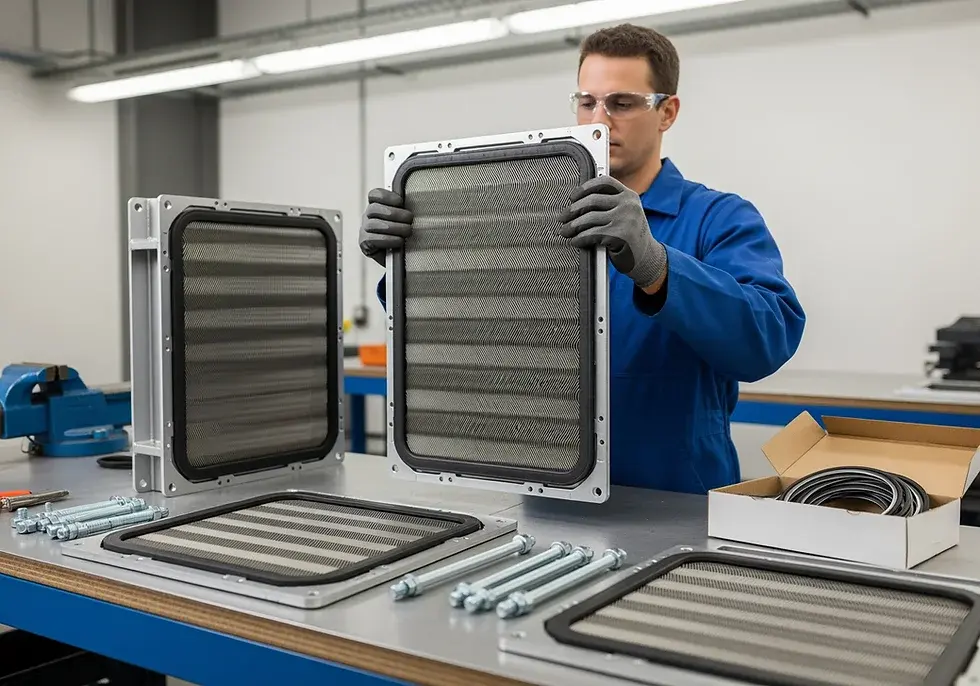
Gasketed plate heat exchangers deliver efficient thermal performance in compact footprints across food processing, HVAC, chemical processing, and pharmaceutical applications. Unlike shell and tube units, plate exchangers use thin corrugated metal plates separated by elastomeric gaskets to create alternating flow channels. This design maximises heat transfer while minimising space requirements.
The gasket system is the foundation of plate exchanger reliability. These elastomeric seals prevent fluid mixing and direct flow through the correct channels. When gaskets degrade, plate heat exchanger gasket failure leads to performance loss, internal bypassing, and leakage risk. Regular maintenance and timely plate heat exchanger regasketing protect equipment investment and prevent costly unplanned shutdowns.
How Gasketed Plate Heat Exchangers Work
Plate and Frame Configuration
Gasketed plate heat exchangers stack thin corrugated metal plates between a fixed frame plate and a movable pressure plate. Each plate carries a gasket in a peripheral groove. Tie bolts compress the entire plate pack, creating leak-tight seals across every plate surface. Hot and cold fluids flow through alternating channels in counter-current or parallel arrangements.
The corrugated plate pattern generates high turbulence at low velocities, producing heat transfer coefficients 3-5 times higher than shell and tube designs. This efficiency allows smaller physical footprints for equivalent thermal duty - an important advantage in space-constrained facilities.
Plate heat exchangers for industrial, food-grade, and pharmaceutical applications are available in gasketed stainless steel, titanium, and alloy construction suited to a wide range of process conditions.
Gasket Function and Flow Direction
The gasket arrangement determines flow configuration. Changing gasket positions modifies thermal performance without replacing plates. Single-pass, multi-pass, and series-parallel arrangements suit different thermal duties and pressure drop requirements. This adaptability makes gasketed plate heat exchangers suitable for changing process requirements over equipment service life.
Why Gaskets Fail in Industrial Service
Thermal and Chemical Degradation
Plate heat exchanger gasket failure occurs through several distinct mechanisms. Understanding each failure mode helps predict service intervals and prevent unplanned downtime.
Thermal degradation accelerates when operating temperatures exceed gasket material limits. Nitrile rubber (NBR) suits applications below 120°C. EPDM handles temperatures to 150°C. Fluoroelastomers (FKM/Viton) extend service to 180°C. Operating continuously near or above these limits hardens the elastomer, causing compression set and eventual leakage.
Chemical attack breaks down elastomers when process fluids contain incompatible compounds. Strong acids, alkalis, and organic solvents degrade different gasket materials at different rates. Selecting compatible gasket compounds for specific fluids prevents premature plate heat exchanger gasket failure from chemical exposure.
Repair and maintenance services include condition assessment and gasket material review, identifying where specification changes will extend service intervals in chemically aggressive applications.
Pressure Cycling and Compression Set
Pressure cycling flexes gaskets repeatedly as systems start and stop. Each cycle compresses and relaxes the elastomer, gradually reducing resilience. High-frequency cycling applications require more frequent gasket replacement than systems operating under continuous load.
Compression set develops as gaskets permanently deform under sustained pressure. New gaskets recover fully when pressure releases. Aged gaskets retain deformation, losing sealing capability progressively. Compression set exceeding 50% of original thickness typically indicates that replacement is required before leakage begins.
Planned heat exchanger maintenance intervals based on operating conditions - rather than arbitrary fixed schedules - optimise gasket service life and reduce unnecessary maintenance costs.
Performance Indicators Requiring Attention
Observable Symptoms of Gasket Deterioration
Several symptoms indicate gasket degradation before catastrophic plate heat exchanger gasket failure occurs. External leakage is the most obvious indicator. Visible fluid weeping at plate pack edges signals gasket failure in progress. Small seepage often appears first, progressing to steady dripping as gaskets deteriorate further.
Reduced thermal performance develops gradually as gaskets lose compression. Inadequate sealing allows internal bypassing between channels, reducing effective heat transfer area. Monitoring outlet temperatures reveals declining performance before leakage begins.
Pressure drop changes also indicate problems. Increasing pressure drop suggests fouling or flow restriction. Decreasing pressure drop may indicate internal bypassing from gasket failure. Tracking both indicators together identifies developing faults early.
Cooling systems analysis provides thermal performance assessment against design specifications, quantifying efficiency degradation and identifying whether cleaning or regasketing is the appropriate next step.
Monitoring and Inspection Frequency
Visual checks every 3-6 months look for fluid weeping at plate edges, corrosion staining, and gasket compression set. Annual pressure testing verifies gasket seal integrity and detects pinhole leaks in plates. Comparing current performance against baseline commissioning data quantifies deterioration accurately.
Planned heat exchanger maintenance intervals should be reviewed annually based on actual performance monitoring data. Facilities with fouling-prone fluids or aggressive process chemicals may need quarterly inspection to prevent unplanned failures.
The Regasketing Process
Systematic Disassembly and Plate Inspection
Professional plate heat exchanger regasketing follows systematic procedures to ensure reliable resealing and restored performance. The process begins with system isolation, complete fluid drainage, and lockout/tagout to ensure safe working conditions.
Loosening tie bolts in the correct sequence prevents plate warping. Recording bolt positions and tightening torques aids reassembly to original specifications. The movable pressure plate slides along guide bars, exposing the full plate pack for inspection.
Plates are removed individually, maintaining sequential order. Numbering plates during removal ensures correct reassembly sequence. Each plate is inspected for corrosion pitting, erosion damage, and stress cracks - defects that become visible once deposits are cleared.
Chemical cleaning during plate heat exchanger regasketing removes scale, fouling, and organic deposits from plate surfaces before new gaskets are installed, restoring both sealing surfaces and heat transfer performance simultaneously.
Gasket Installation and Pressure Testing
Gasket groove preparation ensures proper sealing. Cleaning grooves removes old adhesive and debris completely. New gaskets are installed following manufacturer specifications, with food-grade adhesive or snap-in designs securing gaskets in grooves.
Plates are reassembled in the correct sequence with proper orientation. Compression follows a specific torque sequence, with multiple passes achieving final compression evenly across the plate pack. The final compressed dimension must match manufacturer specifications.
Hydrostatic pressure testing at 1.5 times operating pressure confirms gasket sealing quality. Holding test pressure for the specified duration confirms no leakage before process fluid is reintroduced.
Gasket Material Selection
NBR, EPDM, and Fluoroelastomer Options
NBR EPDM gasket replacement decisions depend primarily on the process fluid chemistry and operating temperature range. Each material suits a defined set of applications.
Nitrile rubber (NBR) suits general-purpose water and mild chemical applications below 120°C. NBR offers good mechanical properties and reasonable chemical resistance at economical cost. It is commonly specified for HVAC, district heating, and non-aggressive process cooling.
Ethylene propylene diene monomer (EPDM) handles hot water, steam, and alkaline solutions to 150°C. EPDM resists oxidation and weathering better than NBR, making it the preferred material for steam systems, hot water applications, and food processing duties. It is not compatible with petroleum products or mineral oils.
Fluoroelastomers (FKM/Viton) provide excellent chemical resistance and temperature capability to 180°C. FKM resists acids, hydrocarbons, and aggressive chemical compounds where standard elastomers would fail quickly. Higher cost is justified by extended service life in demanding chemical processing applications.
Allied Heat Transfer maintains gasket inventory for common gasketed plate heat exchanger models, enabling rapid turnaround for plate heat exchanger regasketing services across Australia.
Selecting for Temperature and Pressure
Operating temperature is the primary selection criterion for gasket material. Selecting materials rated 20-30°C above normal operating temperature extends service life by reducing thermal stress during transient conditions.
Pressure requirements also affect gasket compound hardness. High-pressure applications require harder compounds that maintain compression under sustained load. Low-pressure applications use softer compounds that seal effectively with minimal compression force.
NBR EPDM gasket replacement with upgraded materials - such as HNBR or FKM - extends service intervals in facilities experiencing premature gasket failure at moderate temperatures. The modest material cost increase delivers labour savings from reduced replacement frequency.
Maintenance Scheduling and Service Planning
Condition-Based vs Time-Based Intervals
Establishing planned heat exchanger maintenance intervals maximises equipment reliability while minimising lifecycle costs. Planned maintenance consistently costs less than emergency repairs.
Annual inspections suit most moderate-duty applications. Opening the plate pack for visual inspection takes 2-4 hours depending on unit size. Scheduling inspections during planned shutdowns eliminates production disruption entirely.
Planned heat exchanger maintenance intervals for plate heat exchanger regasketing vary with operating severity. Clean water applications at moderate temperatures may achieve 3-5 years between complete regasketing. Aggressive chemical service or high-temperature operation requires 1-2 year intervals. Performance monitoring should guide actual timing rather than fixed schedules.
Ultrasonic cleaning during scheduled maintenance removes fouling from corrugated plate surfaces without mechanical damage, combining deep cleaning with gasket inspection in a single planned service event.
Documentation and Spare Parts
Maintenance documentation tracks service history and performance trends. Recording regasketing dates, gasket materials used, cleaning procedures, and performance test results builds institutional knowledge for future planning.
Spare parts inventory enables rapid maintenance response. Stocking complete gasket sets for critical units minimises downtime during planned or emergency regasketing. Gaskets have limited shelf life - rotating stock ensures fresh materials are always available.
Workshop vs On-Site Regasketing
Workshop Service for Smaller Units
Workshop plate heat exchanger regasketing provides controlled conditions and complete equipment access. Removing units to specialised facilities enables thorough cleaning, detailed inspection, and comprehensive pressure testing.
Maintenance workshop facilities include ultrasonic cleaning tanks, pressure testing equipment, and specialised tooling for complete overhaul. Climate-controlled environments ensure proper gasket adhesive curing. Quality control procedures verify work before equipment returns to service. Typical turnaround runs 5-10 business days including transport.
Workshop service suits smaller units where removal requires minimal labour. Units below 100 plates typically benefit from workshop service unless removal is impractical due to size or permanent piping integration.
On-Site Service for Large Installations
On-site plate heat exchanger regasketing eliminates transport requirements and suits large permanently installed equipment. Field service teams bring tools, gaskets, and expertise to customer facilities. Scheduling flexibility accommodates production requirements and planned shutdown windows.
Field regasketing requires adequate working space around equipment. Removing and reinstalling plates demands overhead clearance and access from multiple sides. Environmental conditions - particularly temperature and humidity - must suit gasket adhesive curing requirements for the specified material.
Cost Considerations and Return on Investment
Planned vs Emergency Repair Costs
Understanding regasketing cost plate exchanger calculations supports informed maintenance decisions. Complete regasketing for typical industrial gasketed plate heat exchangers ranges from $2,000-$8,000 depending on unit size and gasket material. Specialised gaskets for aggressive chemicals cost more than standard NBR or EPDM.
Emergency repair costs typically run 2-3 times planned maintenance expenses. After-hours labour, expedited parts procurement, and production losses multiply costs significantly. Manufacturing facilities losing $5,000-$50,000 per hour during unplanned shutdowns face substantial costs from equipment failure that could have been prevented.
Energy Savings and Equipment Life
Energy savings from restored thermal performance recover maintenance costs quickly. Degraded heat exchangers increase energy consumption 10-30% before leakage develops. Restored efficiency reduces operating costs from day one of return to service.
Regasketing cost plate exchanger investment also extends equipment service life significantly. Gasketed plate heat exchangers properly maintained achieve 20-30 year service lives. Neglected units may require complete replacement after 10-15 years. Plate replacement costs 5-10 times more than gasket replacement, making regular planned heat exchanger maintenance intervals one of the most cost-effective reliability investments available.
Conclusion
Gasketed plate heat exchangers deliver reliable thermal performance when maintained according to defined service schedules. Understanding gasket failure mechanisms, monitoring performance indicators, and implementing planned heat exchanger maintenance intervals protects equipment investment and prevents costly unplanned failures.
Professional plate heat exchanger regasketing services restore units to original specifications through systematic disassembly, thorough cleaning, careful gasket installation, and comprehensive pressure testing. Selecting appropriate NBR EPDM gasket replacement materials for specific process conditions optimises service intervals and reduces total maintenance costs over equipment service life.
To discuss regasketing services or maintenance programmes for your equipment, speak with our heat exchanger maintenance team on (08) 6150 5928.


