
Custom Shell & Tube Heat Exchangers for Industrial Applications

Updated: Sep 10
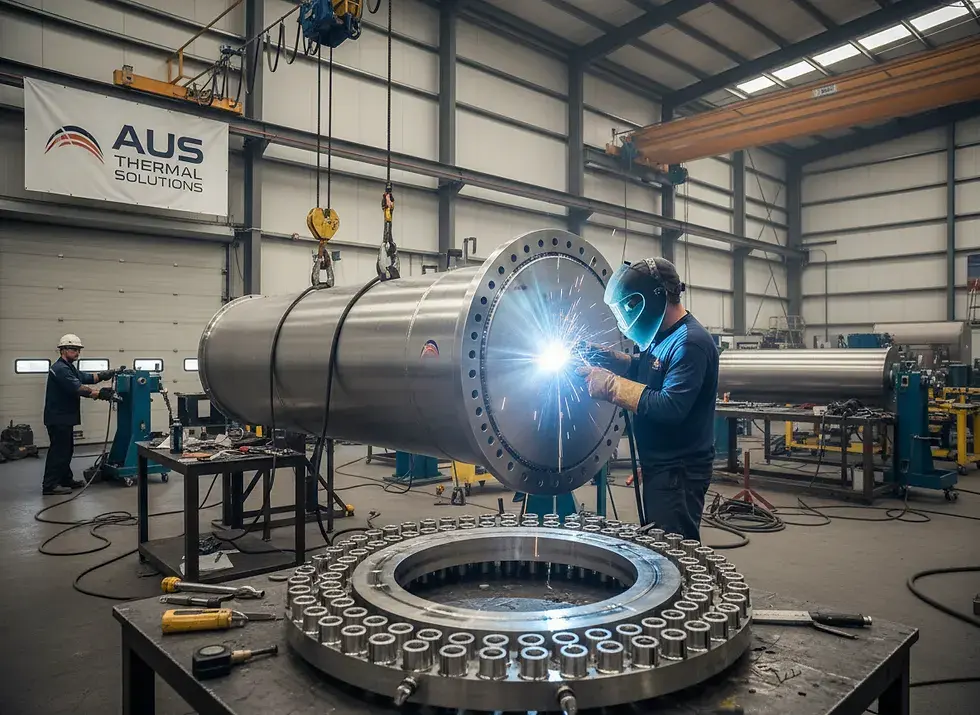
Thermal management failures cost Australian industrial operations millions annually through unplanned downtime, reduced equipment life, and compromised process efficiency. When standard cooling equipment cannot handle specific pressure requirements, corrosive fluids, or extreme operating conditions, shell and tube heat exchangers deliver proven performance across mining, manufacturing, and heavy industry applications.
The difference between adequate and optimal thermal performance often determines whether production targets are met or missed. Shell tube exchangers handle pressures exceeding 3000 kPa, temperatures ranging from -40°C to 400°C, and corrosive fluids that destroy lesser equipment within months. Custom engineering addresses the specific thermal loads, space constraints, and operational demands that off-the-shelf solutions cannot accommodate.
Understanding Shell & Tube Heat Exchanger Design Fundamentals
Shell tube exchangers transfer thermal energy between two fluids through a bundle of tubes enclosed within a cylindrical shell. One fluid flows through the tubes whilst the other circulates around them within the shell, creating efficient heat transfer without mixing the fluids. This fundamental design principle enables reliable operation across diverse industrial applications where fluid separation is critical.
The configuration consists of three primary components: the tube bundle containing multiple parallel tubes, the shell housing that directs fluid flow around the tubes, and the tube sheets that secure tubes at each end whilst maintaining pressure boundaries. Baffles within the shell create turbulent flow patterns that enhance heat transfer coefficients by 40-60% compared to straight-through flow designs.
Pressure Vessel Classification Requirements
Australian Standards AS/NZS 1200 and AS/NZS 3788 govern pressure vessel design and construction, with shell tube exchangers typically classified as pressure vessels when operating above 50 kPa gauge pressure. NATA testing validates design calculations, material selection, and fabrication quality to ensure compliance with regulatory requirements. Allied Heat Transfer maintains AICIP accreditation for pressure vessel manufacture, demonstrating adherence to Australian engineering and safety standards.
Design pressure ratings determine shell thickness, tube wall dimensions, and tube sheet specifications. Mining applications commonly require 1000-2000 kPa ratings to handle high-pressure hydraulic systems, whilst chemical processing may demand 3000+ kPa ratings for reactor cooling circuits. Hydrostatic testing at 1.5 times design pressure verifies structural integrity before commissioning.
Material Selection for Harsh Australian Conditions
Material compatibility with process fluids determines equipment longevity more than any other design factor. Incorrect material selection leads to premature failure through corrosion, erosion, or stress cracking - problems that cost tens of thousands in replacement equipment and lost production time.
Copper-Nickel Alloys for Seawater Applications
Copper-nickel 90/10 and 70/30 alloys resist seawater corrosion whilst maintaining excellent thermal conductivity of 50-52 W/m·K. Coastal mining operations and marine applications benefit from 20+ year service life with minimal maintenance. The passive oxide film that forms on copper-nickel surfaces provides ongoing protection against biological fouling and chloride attack.
Stainless Steel for Corrosive Fluids
316L stainless steel handles acidic and alkaline fluids common in chemical processing and mining operations. The low carbon content (0.03% maximum) prevents carbide precipitation during welding, maintaining corrosion resistance in heat-affected zones. Thermal conductivity of 16 W/m·K requires larger heat transfer surface area compared to copper alloys, but the material's strength at elevated temperatures and resistance to
stress corrosion cracking justify the trade-off.
Carbon Steel with Protective Coatings
Where fluid chemistry permits, carbon steel construction reduces capital costs by 30-40% compared to stainless steel. Epoxy coatings, galvanising, or cathodic protection extend service life in mildly corrosive environments. Mining cooling water circuits and closed-loop glycol systems frequently use carbon steel construction with appropriate corrosion allowances built into wall thickness calculations.
Custom Design Considerations for Industrial Applications
Standard catalogue equipment rarely matches the precise thermal loads, space constraints, and connection requirements of industrial installations. Custom tube design optimises performance whilst accommodating site-specific limitations that would otherwise compromise system effectiveness.
Thermal Rating Calculations
Heat transfer duty (Q) in kilowatts determines the required surface area based on overall heat transfer coefficient (U) and log mean temperature difference (LMTD). Mining hydraulic systems typically require 50-500 kW cooling capacity, whilst process cooling applications may demand 1000+ kW. Accurate thermal design prevents undersizing that leads to inadequate cooling or oversizing that wastes capital and operating costs.
Tube diameter, length, and quantity affect both thermal performance and pressure drop. Smaller diameter tubes (12.7-19.1 mm) provide higher heat transfer coefficients but increase pumping costs through elevated pressure drop. Larger tubes (25.4-38.1 mm) reduce fouling risk in dirty fluids whilst lowering pumping energy by 20-40%. Custom tube design balances these factors for optimal performance.
Baffle Configuration Impact
Segmental baffles create cross-flow patterns that enhance shell-side heat transfer coefficients by directing fluid across tube bundles rather than parallel to them. Baffle spacing of 0.2-1.0 times shell diameter balances heat transfer enhancement against pressure drop penalties. Closer spacing increases turbulence and thermal performance but raises pumping costs through higher pressure losses.
Rod baffles eliminate dead zones where fouling accumulates whilst reducing vibration-induced tube failures. Mining applications with suspended solids benefit from the reduced fouling tendency, extending cleaning intervals from quarterly to annually in typical installations. The turnkey cooling systems approach integrates optimised baffle design with appropriate filtration and flow control.
TEMA Standards and Configuration Options
Tubular Exchanger Manufacturers Association (TEMA) standards define three service classes and standardise nomenclature for front head, shell, and rear head configurations. Understanding TEMA designations ensures proper equipment selection and facilitates communication between engineers, manufacturers, and maintenance teams.
TEMA Class R for Severe Duty
Class R specifications apply to petroleum refining and related processing industries where reliability is critical. Heavy wall thickness, full radiography of welds, and conservative design margins characterise Class R construction. Mining operations handling abrasive slurries or corrosive mine water benefit from the enhanced durability despite 15-20% higher capital costs.
TEMA Class C for Commercial Applications
Class C standards suit general process service where moderate operating conditions prevail. Manufacturing cooling applications, HVAC systems, and light industrial processes typically specify Class C construction. Reduced wall thickness and relaxed inspection requirements lower costs whilst maintaining adequate performance for less demanding services.
Configuration Nomenclature
TEMA designations use three letters to describe exchanger configuration: front head type, shell type, and rear head type. AES configuration (removable channel and cover, one-pass shell, floating head with backing device) enables tube bundle removal for mechanical cleaning whilst accommodating thermal expansion. BEM configuration (bonnet front head, one-pass shell, fixed tube sheet rear head) provides lowest cost construction where chemical cleaning suffices and thermal expansion is manageable.
Integration with Existing Industrial Systems
Successful heat exchanger installation requires coordination with piping systems, electrical infrastructure, and control systems. Thermal performance calculations mean nothing if connection sizes don't match existing piping or mounting arrangements conflict with structural limitations.
Connection Sizing and Orientation
Inlet and outlet connections must match pipe sizes whilst minimising pressure drop through transitions. Undersized connections create bottlenecks that reduce flow rates and compromise thermal performance. Oversized connections waste capital on unnecessary piping and fittings. Standard flanged connections from DN25 to DN300 accommodate most industrial applications, with larger sizes available for high-flow installations.
Vertical versus horizontal mounting affects footprint, maintenance access, and drainage requirements. Horizontal mounting simplifies tube bundle removal for mechanical cleaning but requires greater floor space. Vertical mounting reduces footprint by 40-60% whilst enabling gravity drainage, but complicates maintenance procedures.
Control System Integration
Temperature sensors, flow switches, and pressure transmitters enable automated control and performance monitoring. Thermostatic control valves modulate flow rates to maintain target temperatures within ±2°C. Mining mobile equipment increasingly demands electronic monitoring integrated with machine control systems to prevent thermal damage to hydraulic components and engines. The industrial radiators used in mobile applications share similar control integration requirements.
Performance Monitoring and Maintenance Requirements
Thermal performance degrades over time through fouling, corrosion, and mechanical wear. Monitoring key parameters identifies developing problems before they cause equipment failure or process disruptions.
Fouling Factor Considerations
Fouling resistance increases thermal resistance and reduces heat transfer effectiveness. Clean exchanger performance establishes baseline data for comparison with operating conditions. Temperature and pressure measurements at inlet and outlet connections reveal fouling progression. When approach temperature (difference between outlet temperature and theoretical minimum) increases 15-20% above baseline, cleaning becomes necessary.
Australian mining water quality varies dramatically between sites, with total dissolved solids ranging from 500 to 50,000+ mg/L. High TDS water accelerates scaling on heat transfer surfaces, requiring chemical treatment or frequent mechanical cleaning. Closed-loop systems using treated water or glycol solutions minimise fouling whilst providing freeze protection in cold environments.
Inspection and Cleaning Intervals
Removable tube bundles enable mechanical cleaning using high-pressure water jets or rotary tube cleaners. Fixed tube sheet designs require chemical cleaning through circulation of acidic or alkaline solutions. Mining applications with dirty cooling water typically require quarterly mechanical cleaning, whilst closed-loop systems may operate 2-3 years between services.
Eddy current testing detects tube wall thinning and incipient failures before leaks develop. Annual inspection programmes identify tubes requiring plugging or replacement, preventing contamination between process streams. Allied Heat Transfer provides repair and maintenance services that extend equipment life whilst maintaining thermal performance.
Custom Fabrication Capabilities and Lead Times
Standard catalogue equipment ships within 2-4 weeks but rarely matches specific application requirements. Custom tube design and fabrication for shell tube exchangers require 8-16 weeks depending on size, materials, and complexity. Understanding the custom design and manufacturing process helps project managers plan equipment procurement and installation schedules.
Design Engineering Phase
Thermal calculations, mechanical design, and pressure vessel calculations typically require 1-2 weeks for straightforward applications. Complex designs with multiple passes, unusual materials, or special inspection requirements may extend engineering to 3-4 weeks. Client approval of design drawings and calculations adds 1-2 weeks before fabrication begins.
Computational fluid dynamics modelling optimises baffle spacing and tube layout for applications where standard design methods prove inadequate. Mining slurry cooling and high-viscosity fluid applications benefit from CFD analysis that predicts flow distribution and identifies potential dead zones.
Manufacturing and Testing
Tube bundle assembly, shell fabrication, and final assembly consume 4-8 weeks depending on size and complexity. Pressure vessel certification requires non-destructive testing including radiography or ultrasonic examination of critical welds. Hydrostatic testing at 1.5 times design pressure verifies structural integrity. NATA-accredited testing provides documented evidence of compliance with Australian Standards.
Quality control procedures include dimensional verification, material traceability, and surface finish inspection. Mining applications demanding maximum reliability benefit from enhanced inspection protocols that identify potential defects before commissioning. The 20+ years of manufacturing experience at Allied Heat Transfer enables consistent quality whilst meeting aggressive project schedules.
Cost-Benefit Analysis for Custom Solutions
Custom tube design for shell tube exchangers commands premium pricing compared to standard catalogue equipment, typically 30-50% higher for equivalent thermal capacity. The investment delivers returns through optimised performance, extended service life, and reduced operating costs that standard equipment cannot match.
Capital Cost Components
Material costs represent 40-50% of total equipment cost, with exotic alloys like titanium or Hastelloy dramatically increasing prices. Fabrication labour accounts for 30-40%, whilst engineering, testing, and certification comprise the remaining 10-20%. Larger units benefit from economies of scale, with cost per kilowatt of capacity decreasing as size increases.
Pressure vessel certification adds $2,000-$8,000 depending on design pressure and inspection requirements. NATA testing, documentation, and registration with relevant authorities ensure regulatory compliance whilst providing liability protection for equipment owners.
Operating Cost Considerations
Optimised thermal design reduces pumping energy by minimising pressure drop whilst maintaining required heat transfer performance. A 50 kW hydraulic oil cooler operating 4,000 hours annually with 10 kPa reduced pressure drop saves approximately $400 yearly in pumping costs at $0.25/kWh electricity rates. Over 15-year equipment life, operating cost savings of $6,000 justify higher capital investment in optimised design.
Extended maintenance intervals through appropriate material selection and fouling-resistant design reduce labour costs and production disruptions. Mining operations where downtime costs exceed $10,000 hourly benefit dramatically from reliable equipment that operates 12+ months between maintenance shutdowns.
Conclusion
Shell tube exchangers deliver reliable thermal management for industrial applications where standard equipment cannot meet pressure ratings, corrosive fluid compatibility, or space constraints. Custom tube design optimises thermal performance whilst accommodating site-specific installation requirements that determine project success or failure.
Material selection appropriate to fluid chemistry and operating conditions determines whether equipment lasts 5 years or 25 years. TEMA standards and pressure vessel certification ensure structural integrity and regulatory compliance across mining, manufacturing, and heavy industry applications. Performance monitoring and scheduled maintenance preserve thermal effectiveness whilst preventing unexpected failures.
Australian industrial operations require equipment engineered for harsh conditions, extreme temperatures, and demanding duty cycles. The combination of thermal engineering expertise, NATA-tested fabrication quality, and local manufacturing support positions custom shell tube exchangers as proven solutions for critical cooling applications. For technical consultation on specific thermal management challenges, contact us to discuss custom design requirements and performance objectives.


