
The Risk of Non-Compliance: Legal and Safety Implications for Pressure Vessel Operators

Updated: Aug 19
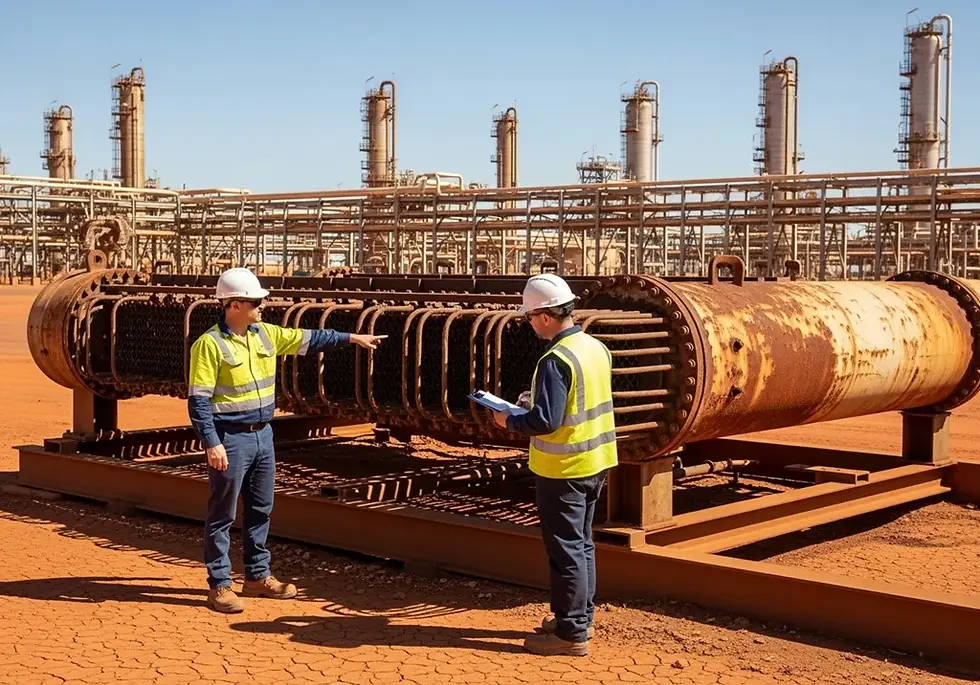
Pressure vessels operate under extreme conditions - high temperatures, corrosive fluids, and pressures that can cause catastrophic structural failure. When these systems fail because compliance obligations have been neglected, the consequences extend well beyond equipment damage. Plant operators face criminal prosecution, facilities shut down, and workers suffer serious injury or death.
Between 2018 and 2023, WorkSafe authorities across Australia issued 47 prohibition notices for non-compliant pressure vessels. Fines reached $1.2 million for serious breaches. These figures cover only documented cases. The true cost includes unreported near-misses, extended production losses, and reputational damage that can destroy decades of business development.
Industrial safety compliance is not optional for operators managing heat exchangers, boilers, or process vessels. It is a legal obligation backed by criminal penalties. This article outlines the key obligations, the consequences of non-compliance, and the framework for building sustainable compliance systems.
The Legal Framework Governing Pressure Vessel Operations in Australia
Work Health and Safety Act Obligations
The Work Health and Safety Act 2011 establishes the primary duty of care. It requires operators to eliminate or minimise risks "so far as is reasonably practicable." This standard carries significant legal weight. Courts have ruled that "reasonably practicable" means operators must implement all safety measures unless cost grossly outweighs the risk reduction. Claiming ignorance of standards or budget constraints rarely constitutes a valid defence.
Every operator of pressure-containing equipment bears a duty of care that cannot be delegated. This applies from a shell and tube heat exchanger in a food processing plant to a high-pressure vessel in a refinery.
AS/NZS 1200 and State-Based Enforcement
AS/NZS 1200:2015 defines pressure equipment design and operation requirements across Australia and New Zealand. The standard specifies design pressure and temperature limits, material selection requirements, and inspection intervals and testing procedures. It also covers record-keeping obligations and competency requirements for operators and inspectors.
State-based regulators enforce WorkSafe regulations through licensing systems. In Western Australia, the Department of Mines, Industry Regulation and Safety requires registration for all pressure vessels operating above specified thresholds. Queensland's Workplace Health and Safety Queensland maintains similar requirements. Penalties for operating unregistered equipment reach $100,000 for individuals and $500,000 for corporations.
Pressure vessel inspections conducted by qualified, NATA-accredited personnel provide the verified documentation that state regulators require when auditing operator compliance with these frameworks.
Key Pressure Equipment That Falls Under These Requirements
Pressure vessel inspection obligations apply to a wide range of industrial equipment. Shell and tube heat exchangers operating at elevated pressures and temperatures in refineries, chemical plants, and mining facilities all require registration and periodic inspection. AS/NZS 1200 pressure equipment compliance applies across this full range of equipment types and operating conditions.
Criminal and Civil Liability for Non-Compliance
Category 1 Offences and Prosecution Outcomes
Pressure vessel failures that cause death or serious injury trigger criminal investigations under Category 1 offences of the WHS Act. These carry maximum penalties of $3 million for corporations and five years imprisonment for individuals. Courts have demonstrated willingness to impose substantial penalties.
A 2019 Queensland manufacturing prosecution illustrates these consequences. A heat exchanger failed catastrophically when operators bypassed safety relief valves to increase production. The resulting steam release caused third-degree burns to two maintenance workers. The company director received an 18-month suspended sentence. The corporation paid $850,000 in fines plus $2.3 million in civil damages.
Liability Beyond the Operator
Pressure vessel operator liability extends beyond the plant operator to a broader group of duty holders.
Directors and officers face personal liability when executives knew or should have known about non-compliance. The "should have known" standard creates significant pressure vessel operator liability risk for senior management who fail to implement adequate compliance systems.
Maintenance contractors share liability for work performed on pressure equipment. A Brisbane contractor faced prosecution after reinstalling a tube bundle without proper pressure vessel testing. The resulting leak hospitalised three workers.
Design engineers who specify non-compliant equipment or modifications bear responsibility for resulting failures. Professional indemnity insurance rarely covers criminal penalties or intentional non-compliance.
Civil liability operates separately from criminal prosecution. Injured workers can pursue common law damages regardless of criminal case outcomes. These claims often exceed statutory workers' compensation limits, particularly for permanent disabilities or fatalities.
Repair and maintenance services performed by qualified, certified personnel - with complete documentation of procedures and test results - provide the evidence base needed to demonstrate compliance.
Common Compliance Failures and Their Consequences
Inadequate Inspection Regimes and Unauthorised Modifications
Analysis of Australian pressure vessel incidents reveals recurring patterns of non-compliance. Inadequate inspection regimes are the most common failure. Many operators treat mandatory inspection intervals as guidelines rather than requirements.
A Perth mining operation received a $450,000 fine after a heat exchanger failed due to corrosion that would have been detected during required annual inspections. The facility had extended inspection intervals to 24 months to reduce maintenance costs.
Unauthorised modifications are equally serious. Adding nozzles, changing pressure relief settings, or altering vessel internals without engineering review invalidates the original design certification. These modifications require complete recertification before safe operation can resume.
Operating Beyond Design Limits and Record Keeping Failures
Operating beyond design limits is a direct WHS Act pressure vessel duty breach. Pressure vessels carry nameplates specifying maximum allowable working pressure (MAWP) and design temperature. Operating beyond these limits - even temporarily to meet production targets - can cause material degradation or immediate failure.
A Queensland chemical processor faced prosecution after operating a shell and tube heat exchanger at 120% of design pressure during a peak demand period.
Inadequate record keeping is a compliance failure that is entirely preventable. Regulators require operators to maintain original design calculations and drawings, material test certificates, fabrication and inspection records, and complete repair and modification histories. Missing documentation results in prohibition notices requiring vessel removal from service.
Cooling systems analysis provides documented engineering assessment of system condition, operating parameters, and compliance status. This creates the verified record base that supports regulatory compliance and informed maintenance decision-making.
Industry-Specific Compliance Challenges
Mining and Resources Sector
Remote mine sites across Western Australia and Queensland operate industrial cooling systems under harsh conditions - extreme temperatures, vibration, dust contamination, and limited access to qualified inspectors. FIFO maintenance crews may lack pressure vessel expertise, leading to improper repairs or missed inspection requirements.
Mobile equipment cooling systems experience accelerated wear from constant vibration and shock loading. This requires more frequent pressure vessel inspection than stationary installations.
Water scarcity in Pilbara operations drives use of air cooled heat exchangers rather than water-cooled systems. These units require different inspection approaches, focusing on fin condition, fan operation, and tube integrity rather than water chemistry and fouling. Allied Heat Transfer provides industrial safety compliance support for air cooled systems and pressure vessels across remote Australian mining and resources operations.
Thermal consultancy services can assess degradation rates specific to remote and harsh-environment applications. These services recommend adjusted inspection intervals supported by engineering analysis.
Oil and Gas and Process Industries
Upstream, midstream, and downstream facilities handle corrosive fluids at high pressures and temperatures. Sour gas service requires exotic materials like duplex stainless steel or Monel to prevent sulphide stress cracking. Material verification through positive material identification (PMI) testing becomes essential during inspections to confirm original specifications remain intact.
Offshore platforms face additional regulatory oversight from NOPSEMA (National Offshore Petroleum Safety and Environmental Management Authority). AS/NZS 1200 pressure equipment compliance must be maintained alongside offshore safety regulations.
Chemical processing, food production, and pharmaceutical manufacturing operate pressure vessels under varying conditions. Thermal cycling during batch processes accelerates fatigue damage. Standard inspection intervals may prove inadequate for equipment experiencing hundreds of pressure and temperature cycles annually.
Building Effective Compliance Management Systems
Asset Registers, Procedures, and Training
Systematic approaches to industrial safety compliance reduce risk and demonstrate due diligence if incidents occur. Effective systems start with complete asset registers covering all pressure equipment. These registers must include unique identification numbers, design specifications and limitations, original certifications, inspection and test schedules, and repair and modification histories.
Written procedures for operation, maintenance, inspection, and emergency response demonstrate commitment to safety. These documents should reference applicable standards and specify competency requirements for personnel. Documentation of all training - with attendance records and competency assessments - demonstrates that personnel are qualified to perform assigned tasks. This is a specific WHS Act pressure vessel duty requirement that WorkSafe inspectors verify during audits.
On-site project work teams can support planned inspection programmes with field engineering capability to address findings immediately. This reduces the gap between inspection and remediation.
Inspection Planning and Incident Investigation
Prohibition notice industrial plant actions typically result from reactive compliance - operators who address inspection only after regulatory contact. Proactive risk-based inspection programmes prioritise equipment based on consequence of failure and likelihood of defects. High-risk vessels receive more frequent and thorough pressure vessel inspection than lower-risk equipment.
Near-misses and minor failures provide warning signs of systemic problems. Investigate all pressure equipment incidents to identify root causes. Implement corrective actions before they escalate. Organisations that penalise workers for stopping unsafe operations inevitably face serious incidents.
A maintenance workshop with appropriate certification and qualified inspectors provides the technical capability needed to assess defects found during planned inspections. This ensures findings translate into effective repairs rather than deferred risks.
Consequences of Prohibition Notices and Enforcement Actions
Production Losses and Emergency Replacement Costs
Regulatory prohibition notices immediately halt operations involving non-compliant equipment. The financial impact extends well beyond direct fines.
A single day of downtime can cost mining operations hundreds of thousands of dollars. Manufacturing facilities miss delivery commitments and trigger contract penalties. The 2021 prohibition of a Queensland refinery cooling system cost an estimated $3.2 million in lost production during the eight-week rectification period.
Prohibited equipment often requires immediate replacement. Standard lead times for custom pressure vessels range from 8 to 12 weeks. Expedited manufacture increases costs by 40 to 60%. Turnkey cooling systems with pre-engineered configurations can reduce replacement lead times compared to fully custom designs. Planned compliance is always more cost-effective than emergency replacement.
Reputational and Insurance Implications
Safety violations become public record through regulator websites and media coverage. Major mining companies now require clean safety records from service providers. Operators with recent prohibition notice industrial plant history can be excluded from future contracts. Reputational damage can persist even after penalties are paid and equipment is rectified.
Non-compliance may void equipment insurance or increase premiums substantially. Some insurers now require proof of current inspection certificates before providing coverage for pressure equipment. The cost of non-compliance extends across every aspect of the business - not just the regulatory penalty itself.
Conclusion
Industrial safety compliance protects workers, preserves operational continuity, and limits legal liability. Criminal penalties reaching $3 million and five-year prison sentences demonstrate how seriously Australian regulators treat WorkSafe regulations breaches. Civil liability adds millions more in potential damages.
Effective compliance requires complete documentation, qualified personnel, proper pressure vessel testing, and organisational commitment to safety. The investment in proper inspections, maintenance, and repairs costs a fraction of the potential liability from non-compliance. AS/NZS 1200 pressure equipment compliance, when managed proactively, is an operational risk management tool - not an administrative burden.
For pressure vessel inspection scheduling, compliance assessment, or testing services, contact our heat exchanger compliance specialists or call (08) 6150 5928.


