
The Lifecycle of a Heat Exchanger: When to Stop Repairing and Start Replacing

Updated: Aug 19
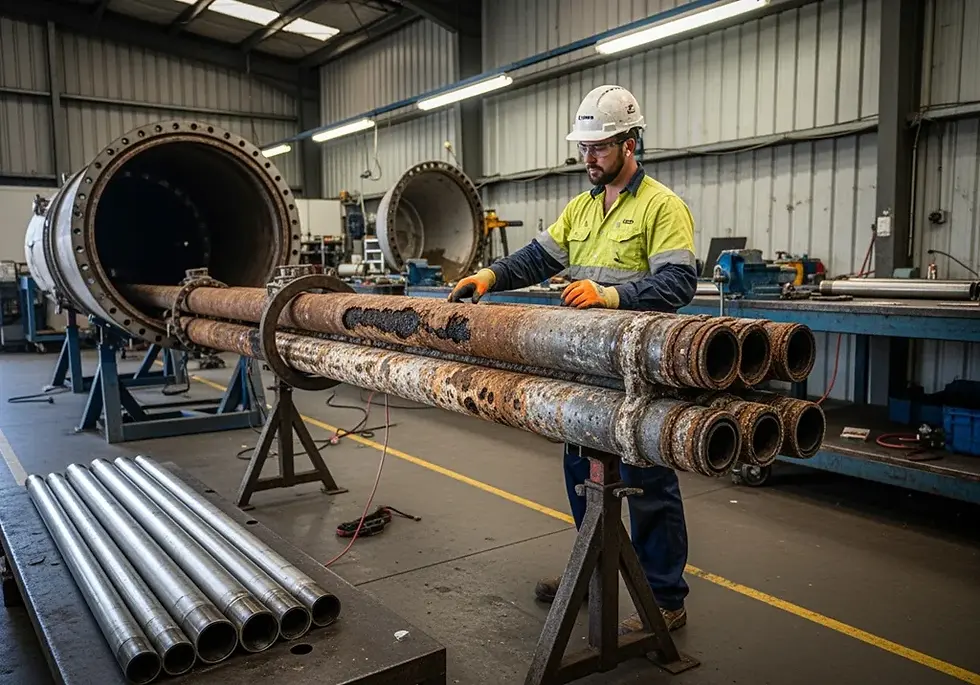
Every maintenance manager faces this question at some point: is it worth repairing this heat exchanger again, or has it reached the point where replacement delivers better economics? The decision is rarely obvious at the moment it needs to be made. A repair can look cheaper than a replacement on the face of it - until the same unit fails again months later, or continues operating at degraded performance that quietly erodes production capacity and increases energy costs.
Heat exchangers do not announce their retirement date. They degrade gradually through fouling, corrosion, mechanical fatigue, and accumulated damage from thermal cycling. The challenge is identifying when routine maintenance crosses into diminishing returns. At that point, continued repair investment compounds operational costs rather than recovering them.
This article provides a practical framework for the heat exchanger repair vs replace decision - covering service life expectations, the indicators that signal end of economic life, how to calculate total cost of ownership accurately, and the replacement options available when the decision is made.
Understanding Heat Exchanger Service Life
Service Life Expectations by Application
Typical heat exchanger service life varies significantly by application and operating conditions. Shell and tube heat exchangers in clean service with well-managed water chemistry can operate for many years with proper maintenance. Units handling corrosive fluids, operating at elevated temperatures, or experiencing frequent thermal cycling reach end of life considerably earlier. The difference between these extremes is driven by the cumulative degradation rate in each service environment.
Industrial radiators in mobile mining equipment face particularly demanding conditions. Continuous vibration, thermal cycling from repeated start-stop operation, and exposure to contaminated cooling water accelerate wear at rates not experienced by stationary process exchangers. Shell and tube lifecycle assessment for these applications reflects operating hours and duty cycle rather than calendar age alone.
Material selection at initial purchase significantly affects how long a unit remains economically viable. A carbon steel unit in mildly corrosive service will reach its replacement threshold earlier than a stainless steel unit in the same application. The upfront cost difference between these material choices frequently represents a fraction of the total lifecycle cost difference.
Operating Environment and Degradation Rate
Two identical heat exchangers placed in different operating environments can reach their economic end of life at very different times. A coastal installation faces accelerated corrosion from salt-laden air and the chloride content of cooling water. A Pilbara mining application contends with extreme ambient temperatures, dust ingress, and water chemistry that varies with source conditions. Each environment creates specific failure modes that dictate how quickly degradation accumulates.
Heat exchanger replacement decision timing is therefore a site-specific calculation, not a rule based on equipment age. A unit that would justify replacement after ten years in a demanding service might reliably serve twenty years in a clean, controlled environment. Condition data from regular inspection programmes provides the objective basis for this assessment - replacing equipment based on age alone is as likely to discard serviceable assets prematurely as it is to catch units that genuinely need replacement.
Shell and tube heat exchangers operate across a wide range of service conditions in Australian industry. The maintenance history and condition data accumulated through regular inspection is the most reliable predictor of remaining service life for any specific unit.
Key Indicators That Repairs Are No Longer Cost-Effective
Repair Frequency and Thermal Performance Decline
Repair frequency provides the clearest early signal that a heat exchanger is approaching its economic end of life. When a unit requires significant repairs multiple times per year, the cumulative direct cost of those repairs - combined with repeated production downtime - typically favours replacement over continued maintenance investment. Each repair cycle also carries the risk that the next failure will occur at a more expensive time.
Declining thermal performance despite clean tubes and proper flow rates is a more definitive signal. If a recently serviced unit cannot achieve design outlet temperatures or maintain design approach temperature, internal damage has progressed beyond what surface maintenance can address. This often indicates tube-to-tubesheet joint deterioration, shell-side bypass flow from baffle damage, or tube wall thinning that reduces heat transfer area below minimum requirements. These conditions are not recoverable through cleaning or minor repair.
Multiple tube failures across different sections of a tube bundle signal systemic degradation rather than isolated incidents. A single tube failure caused by external impact or localised corrosion is economically repairable. When ultrasonic testing reveals wall thinning distributed across a significant proportion of the bundle, the entire tube population is approaching end of life simultaneously. Progressive tube plugging reduces capacity with each repair cycle until performance can no longer meet process requirements.
Pressure Vessel Integrity Issues
Pressure vessel integrity issues create replacement urgency that goes beyond economic analysis. Cracks in shell welds, nozzle attachment failures, or shell wall thinning below minimum thickness requirements cannot be addressed through routine maintenance. These conditions require either major structural repair - which must be certified under applicable pressure vessel standards - or complete unit replacement.
Pressure vessel inspections conducted by accredited inspectors identify these conditions through ultrasonic thickness testing, visual examination, and NDE methods. When an inspection reveals wall thickness below the minimum required by AS1210 or the unit's design standard, regulatory compliance creates a hard deadline for remediation or replacement that overrides economic analysis.
The safety and regulatory implications of operating equipment with known integrity deficiencies extend beyond compliance obligations. Workplace health and safety duty of care requires maintenance managers to address equipment that presents known risks. This duty sometimes necessitates replacement decisions ahead of what pure economic analysis would suggest.
Calculating Total Cost of Ownership for the Repair vs Replace Decision
Beyond Direct Repair Costs
A direct cost comparison between repair and replacement consistently underestimates the true cost of continuing to repair. Direct repair costs - labour, parts, and downtime for the specific repair event - represent only a portion of the real economic impact of ageing equipment.
Energy efficiency degradation creates ongoing operating costs that compound over time. A fouled or partially plugged heat exchanger forces auxiliary cooling equipment to work harder to compensate. Pumps operate against higher resistance. Fan systems run longer to maintain outlet temperatures. These efficiency losses translate directly to increased energy expenditure that persists between maintenance events and is rarely attributed to the heat exchanger specifically.
Maintenance labour allocation matters in the total cost calculation. Technicians spending significant time on one problematic unit have less capacity for preventative maintenance on other equipment. This hidden cost appears as unexpected failures elsewhere - equipment that would have been caught by scheduled inspection that did not occur because resources were deployed elsewhere.
Downtime Frequency and Risk Costs
The heat exchanger repair vs replace decision threshold shifts significantly when downtime costs are included. In continuous process operations, an unplanned heat exchanger failure can stop an entire production line. The production loss during an unplanned shutdown typically costs multiples of the repair bill itself, particularly when emergency labour rates and expedited freight costs are added.
Throughput reduction from degraded cooling capacity is a cost that often goes unquantified. Plant operators who reduce production rates to manage temperatures with an underperforming heat exchanger are incurring a continuous revenue loss that does not appear on the maintenance budget but is nonetheless real. Accumulated over months or years, this loss can exceed the capital cost of replacement several times over.
Cooling systems analysis that quantifies actual versus design thermal performance provides the data needed to calculate the true cost of continued operation with degraded equipment. This analysis converts an intuitive sense that performance has declined into a defensible financial case for replacement.
When Repair and Refurbishment Still Make Economic Sense
Strategic Refurbishment Extending Service Life
Comprehensive refurbishment can extend service life significantly for equipment where the shell and structural components remain fundamentally sound. Complete re-tubing with upgraded tube materials, full gasket replacement, baffle inspection and replacement where needed, and pressure testing restores design performance while addressing the root cause of previous failures through material selection improvement.
Repair and maintenance services that include a full internal inspection alongside the re-tube work identify any developing shell-side issues before they become the next failure point. This comprehensive approach to refurbishment delivers longer post-repair service life than a narrowly scoped tube replacement that leaves other degraded components in place.
The economics of refurbishment improve significantly when work is scheduled during planned shutdowns. Addressing multiple maintenance items in a single planned outage eliminates the production impact of repeated emergency interventions and enables thorough inspection that reactive repairs do not permit.
Minor Repairs and Planned Maintenance Windows
Minor tube leaks caught early through regular inspection programmes are economically justified to repair. Tube plugging, end cap replacement, and localised corrosion repairs cost a fraction of replacement and maintain most of the unit's capacity when failures are isolated and detected before they cascade.
The key qualifier is timing and detection. Early detection through condition monitoring programmes converts expensive emergency repairs into planned maintenance events. The same repair performed during a scheduled shutdown, with parts pre-ordered and technicians booked in advance, costs substantially less than the same repair performed as an emergency response to a production-threatening failure.
The Hidden Costs of Delaying Asset Replacement
Declining Reliability and Operational Compromises
Delaying replacement beyond the economic end of life creates costs that accumulate silently. Throughput reduction from inadequate cooling capacity represents recurring revenue loss rather than a one-time maintenance event. Production rates reduced to manage temperatures with an underperforming exchanger - sometimes for months or years - can represent a total production loss that exceeds replacement cost many times over.
Emergency repairs on ageing equipment cost substantially more than planned maintenance. After-hours call-out rates, expedited freight for parts not held in stock, and premium pricing for urgent contractor availability convert a manageable maintenance cost into a crisis expenditure. Multiple emergency interventions in a year quickly accumulate costs that would have justified planned replacement.
Catastrophic failures create secondary damage that extends well beyond the heat exchanger itself. A tube bundle failure that allows process fluid to contaminate cooling water, or cooling water to enter process fluid, can damage downstream equipment, create environmental compliance issues, and require system decontamination that costs multiples of the original replacement value.
Safety, Regulatory, and Insurance Implications
Allied Heat Transfer manufactures replacement heat exchangers to AS1210 and ASME standards, with NATA-accredited testing confirming compliance before equipment enters service. For equipment where condition assessment indicates replacement timing, having a technically confirmed replacement specification and delivery schedule eliminates the uncertainty that encourages deferral.
Insurance requirements sometimes specify maximum equipment age or minimum condition standards that create additional replacement timelines independent of maintenance economic analysis. Equipment beyond these thresholds may lose coverage, creating a liability exposure that mandates replacement regardless of operational condition.
Replacement Options and Upgrade Opportunities
New Equipment and Remanufactured Units
New heat exchanger equipment incorporates design improvements - enhanced tube geometries, improved alloy options, and optimised thermal layouts - that were not available when older units were specified. These improvements often deliver measurably better thermal efficiency and longer service intervals than the equipment being replaced, improving the economics of replacement beyond simple like-for-like substitution.
Remanufactured units from established manufacturers offer a middle-ground option. Complete rebuilds with new tube bundles, gaskets, and critical components - retaining serviceable shell assemblies where condition allows - typically cost less than full new equipment while delivering service life approaching a new unit. This option is worth evaluating where the existing shell has remaining service life and the internal components are the primary source of degradation.
Turnkey cooling systems provide an opportunity at replacement time to address changed process requirements that the original equipment was not designed for. Production expansions, process modifications, or changed fluid properties may mean that a direct replacement of the existing unit perpetuates a design that no longer matches current needs.
Using Replacement to Address Changed Process Requirements
Replacement creates an opportunity to reconsider the thermal technology, not just renew the existing configuration. Where water availability is a concern, replacement with air cooled heat exchangers eliminates process water dependency. Where footprint is constrained, plate heat exchangers offer higher efficiency in smaller volumes for suitable services. Where integration with other thermal equipment is the priority, a turnkey cooling system approach delivers an optimised whole-system solution.
Thermal consultancy at the replacement specification stage ensures the new equipment is sized and configured for actual current and projected process requirements - not the conditions that existed when the original unit was specified, which may have changed significantly over the equipment's service life.
A Practical Framework for the Replacement Decision
Condition Assessment and Cost Calculation
A well-structured replacement decision begins with objective condition data. Professional inspection including ultrasonic thickness testing, tube bundle examination, and pressure vessel certification review provides the equipment condition picture that replaces assumption with measurement. This assessment identifies specific degradation mechanisms, quantifies remaining wall thickness margins, and highlights any integrity issues that create regulatory timelines.
The cost calculation compares total annual maintenance costs over a representative period against new equipment cost. Include direct repair costs, downtime losses, emergency service premiums, and efficiency-related energy increases. When this total annual cost consistently approaches or exceeds a significant fraction of replacement cost, the economic case for replacement is clear regardless of whether the unit is still technically operable.
Future Process Requirements and Regulatory Timing
Equipment condition and current maintenance cost are not the only inputs to the replacement decision. Future process requirements - planned production increases, process chemistry changes, or integration with new equipment - may make the current unit inadequate regardless of its condition. Investing in refurbishment of a unit that will not meet future requirements delays replacement without providing sustainable value.
Total cost of ownership analysis that projects maintenance costs and production losses over the next five to ten years, compared against the annualised cost of replacement with modern equipment, provides the most complete basis for the heat exchanger replacement decision. This analysis prevents both premature replacement of serviceable assets and the costly deferral of replacement past the economic optimum.
For technical consultation on heat exchanger condition assessment and replacement planning, contact our heat exchanger specialists or call us on (08) 6150 5928.
Conclusion
The heat exchanger repair vs replace decision is an economic analysis, not an age-based rule. Repair frequency, thermal performance decline, pressure vessel integrity, and total cost of ownership - including downtime, energy penalties, and risk - determine when continued maintenance investment delivers diminishing returns. Most industrial heat exchangers reach their economic end of life before they reach complete mechanical failure, and the costs of delay accumulate in ways that are rarely fully visible until they are reviewed in hindsight.
Condition assessment based on measured data rather than age or appearance provides the objective foundation for this decision. Combined with an accurate total cost of ownership calculation that includes all operational costs - not just direct maintenance - this assessment enables replacement decisions that are both financially sound and operationally timely.


