
Operational Planning: Minimising Plant Downtime During Critical Heat Exchanger Swaps

Updated: Sep 10
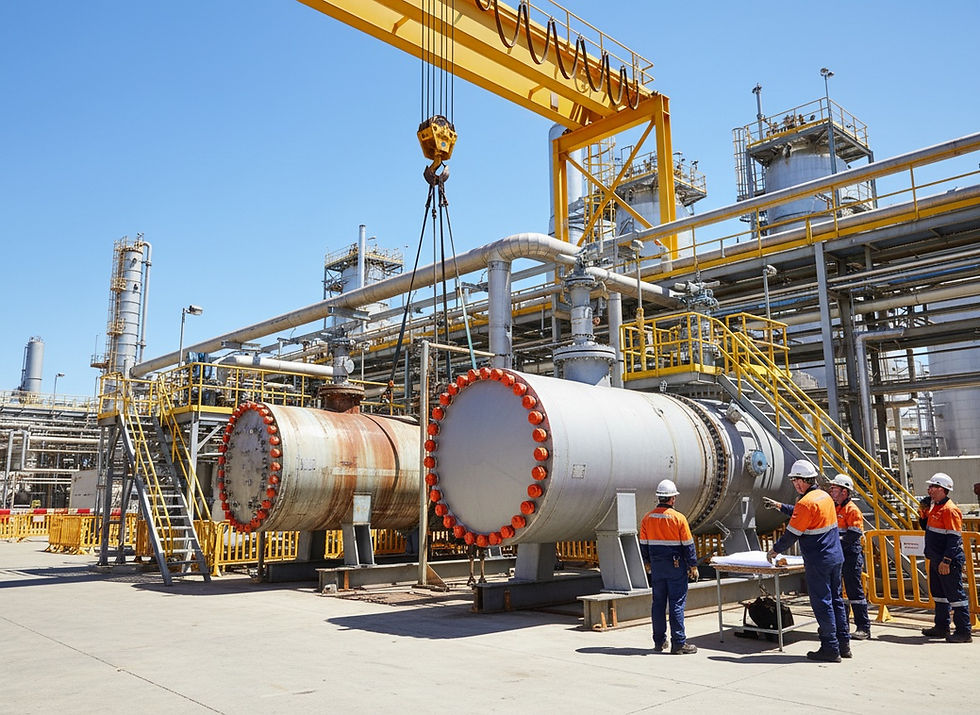
A critical heat exchanger swap can affect isolation, lifting access, pipework, instrumentation, testing, and plant restart. The replacement itself is only one part of the outage. Delays often arise when site interfaces or decision points remain unclear until the equipment is already offline.
Minimising plant downtime starts with a defined heat exchanger replacement scope and a realistic work sequence. Maintenance, operations, engineering, procurement, and contractors need the same information before isolation begins. The plan should also explain how unexpected findings will be handled without turning every discovery into an uncontrolled scope change.
Define the Replacement Scope Before the Outage
Confirm What Is Actually Being Replaced
The term "heat exchanger swap" can describe different work. It may mean replacing a complete exchanger, installing a tube bundle, changing a plate pack, or removing a unit. Workshop work may then form part of the plan.
That distinction matters because each option changes access, handling, materials, and testing requirements. A useful scope identifies the exact equipment boundaries and the components expected to remain in service.
For shell and tube exchangers, several components can affect the replacement decision. These include the shell, channel heads, tubesheets, bundle, nozzles, supports, and sealing faces. A bundle change does not resolve unrelated shell or nozzle deterioration.
Build the Scope From Condition Evidence
A heat exchanger replacement plan should use available condition and service information. Useful sources include inspection findings, leak history, repair records, cleaning history, drawings, and operating information. This reduces assumptions before the shutdown begins.
Allied Heat Transfer's repair and maintenance service includes cleaning, testing, repair, rebuilding, re-tubing, and re-coring. The current service description also notes that performance effects can be assessed when changes may alter exchanger operation.
This makes condition evidence important before deciding whether the outage needs a direct replacement, refurbishment, re-tubing, or another maintenance response. The plan should not assume replacement is always the correct answer.
Set Decision Points Before Isolation
Some defects only become visible after covers, plates, or bundles are removed. The work pack should therefore identify which findings can be handled within the approved scope.
It should also identify which findings need engineering review before work continues. This approach supports minimising plant downtime because decisions are prepared before the plant is waiting for an answer.
A clear decision path also prevents pressure to approve unsuitable changes simply because the exchanger is already offline.
Plan the Site Sequence Around Access and Interfaces
Coordinate Isolation, Draining, Access, and Handling
Replacement planning should begin with the physical work area. Isolation, draining, access, lifting, work-area controls, temporary protection, and component handling all need coordination.
Allied Heat Transfer's on-site project work covers repair, rebuild, re-tubing, and replacement at client facilities. The service description also states that site work follows documented work instructions and applicable testing requirements.
On-site capability does not mean every exchanger should be replaced in place. Available space, transport practicality, equipment condition, repair complexity, and site controls should guide the decision.
Check Removal and Installation Paths
A replacement exchanger may fit the operating space but still be difficult to remove. Installation can create different access constraints. The plan should check structures, platforms, pipework, cable routes, and adjacent equipment.
Removable tube bundles also need withdrawal space and a controlled handling path. Plate units may need clear access for frame work and connection changes. Air-cooled equipment can involve additional structural and fan-access considerations.
Where relevant, plate heat exchangers may be serviced, cleaned, regasketed, or replaced through Allied Heat Transfer's published workshop capabilities. The exact project route should still be confirmed against the installed unit and site conditions.
Confirm Materials and Tools Before Disassembly
Required gaskets, seals, fasteners, tubes, plates, fittings, and tooling should be checked before the outage. Confirm availability where practical. The goal is not to carry unnecessary stock. It is to avoid discovering an obvious material gap after disassembly.
For a planned heat exchanger replacement, drawings and material records should also be checked against the equipment in service. Site modifications made during earlier maintenance can create differences between drawings and actual connections.
Minimising plant downtime is easier when these differences are identified before lifting or disconnection begins.
Control Scope Changes Without Losing the Shutdown
Record New Findings as the Unit Is Opened
Unexpected findings should be recorded before the scope changes. Photographs, marked drawings, inspection notes, and material identification can help explain what changed.
The maintenance workshop described by Allied Heat Transfer covers rebuilding, refurbishing, re-tubing, modifying, and replacing heat-transfer equipment. Workshop work may suit projects needing controlled disassembly, cleaning, inspection, fabrication, or testing.
That option should be considered during planning, not treated as an automatic fallback. Transport, access, repair scope, and operational requirements still determine suitability.
Review Non-Like-for-Like Changes
A replacement that appears mechanically similar can still affect thermal or hydraulic behaviour. Material changes, altered geometry, connection changes, or different process conditions need engineering review.
Allied Heat Transfer's thermal consultancy page lists thermal modelling, HTRI, CFD, CAD, and mechanical calculation capabilities for heat-transfer equipment. These capabilities can support evaluation where a proposed change may affect performance.
They should not be presented as a guarantee of a particular operating result. The purpose of review is to understand the proposed change before it becomes part of the repair decision.
Keep Change Control Visible to Operations
Operations teams need to know when the replacement scope changes. A new material, altered connection, additional repair, or testing requirement can affect the restart plan.
Where actual system behaviour needs investigation, cooling systems analysis can provide thermal and mechanical checking of existing installations. Allied Heat Transfer states that diagnostic equipment is used to map operating conditions and support analysis.
Performance analysis can inform the project, but it does not replace mechanical inspection or acceptance testing. Each activity should have a defined purpose in the shutdown plan.
Prepare Verification and Handover Before Restart
Define Acceptance Requirements Early
Testing should not be planned after installation is complete. The project team should define required inspections, checks, documentation, and acceptance criteria before the exchanger is removed.
The exact requirements depend on the exchanger design, completed work, and applicable site obligations. Pressure-boundary work may require different verification from a connection-only replacement.
For air cooled exchangers, replacement planning may include several equipment areas. Headers, tube bundles, structural frames, fans, and installed access can all affect the work. The actual scope should follow the unit configuration.
Build the Handover Package During the Job
A useful handover record explains what was removed, installed, changed, and verified. It should not rely on a simple statement that the swap was completed.
Material records, inspection notes, test records, updated drawings, and approved deviations should be captured while the information is available. This reduces later uncertainty about the completed heat exchanger replacement.
Allied Heat Transfer presents design, manufacture, maintenance, repair, cleaning, and industrial cooling capabilities for heat-transfer equipment. Project teams can use the published service scope when deciding what support is relevant to a planned outage.
Treat Restart as Part of the Replacement Plan
Restart preparation should begin before final assembly. Operations need clear confirmation of equipment status, completed checks, open actions, and any changed operating considerations.
Minimising plant downtime does not mean rushing commissioning. It means reducing avoidable waiting while preserving the checks required for a controlled return to service.
A well-prepared restart also creates a new operating baseline. Early observations can then support future maintenance and troubleshooting without relying on memory.
FAQs
What Should Be Confirmed Before a Critical Heat Exchanger Swap?
Confirm the replacement boundary, current equipment condition, drawings, materials, access, isolation, handling method, testing requirements, and decision authorities.
The plan should also identify likely scope-change triggers. That gives the team a controlled response when new findings appear.
Can Heat Exchanger Replacement Work Be Completed On-Site?
It can be suitable for some equipment and site conditions. Allied Heat Transfer states that its on-site project work includes repair, rebuild, re-tubing, and replacement.
Suitability depends on access, work controls, equipment condition, transport practicality, inspection needs, and the required repair scope.
How Does Planning Help With Minimising Plant Downtime?
Planning reduces avoidable waiting caused by missing information, unclear responsibilities, unconfirmed materials, or late decisions.
It cannot guarantee that every delay will disappear. Unexpected equipment condition can still change the scope once the exchanger is opened.
Should a Replacement Always Be Like-for-Like?
Not automatically. A like-for-like approach may be appropriate, but the installed duty and equipment history should still be checked.
If materials, geometry, connections, or process conditions have changed, engineering review can help determine whether the proposed replacement remains suitable.
Conclusion
A critical exchanger swap is easier to control when the project begins with condition evidence and a defined scope. Access, materials, lifting, inspection, engineering review, testing, and handover should be planned as one sequence.
Minimising plant downtime is therefore a coordination task as much as a maintenance task. A controlled heat exchanger replacement plan reduces avoidable uncertainty without promising that every outage risk can be removed.
To discuss planning for site-based replacement or refurbishment work, contact the project team.


