
Drill Rig Cooling Systems: V-Pack Coolers for Australian Mining Conditions

Updated: Sep 10
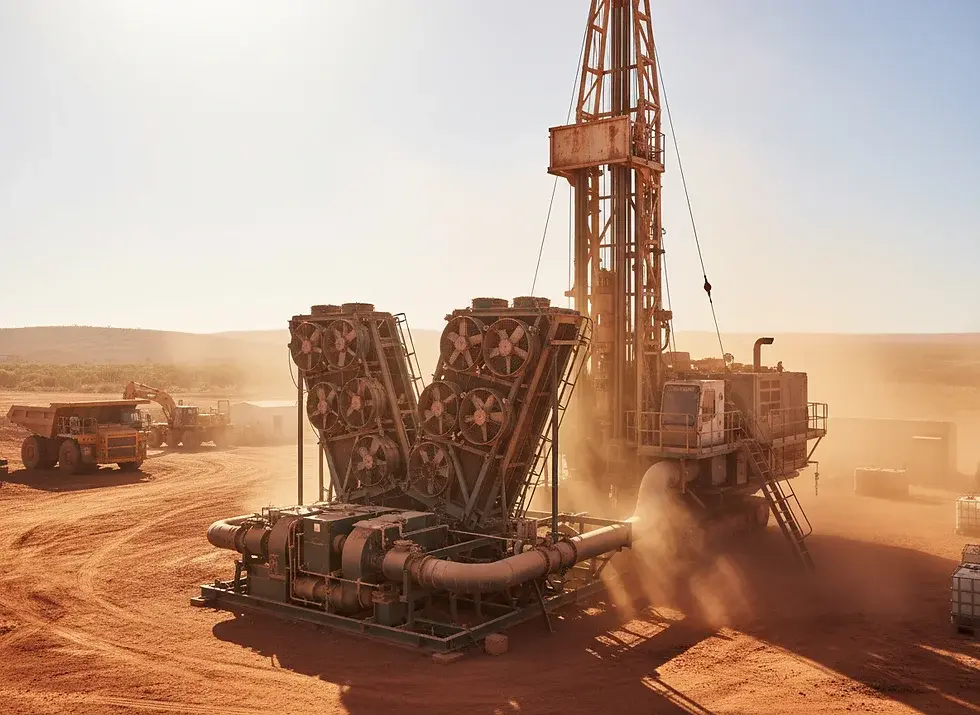
Drill rigs operating in Australian mining environments face thermal challenges that would cripple equipment designed for milder climates. When ambient temperatures exceed 45°C and dust loads reach levels that blind conventional cooling systems within hours, standard radiator configurations simply cannot maintain the hydraulic oil and engine temperatures required for continuous operation.
The operational reality at mine sites across the Pilbara, Bowen Basin, and central Queensland demands cooling solutions engineered specifically for these extreme conditions. Drill rig coolers must handle high heat rejection loads whilst resisting dust ingestion, managing airflow restrictions, and maintaining performance through temperature swings that can exceed 30°C between day and night operations.
Why Conventional Cooling Systems Fail in Australian Mining
Traditional radiator designs struggle in mining
environments for three primary reasons: inadequate dust resistance, insufficient cooling capacity, and poor airflow management under high ambient conditions.
Standard automotive-style radiators position cooling fins horizontally, creating surfaces that accumulate dust rapidly. Within 8-12 hours of operation in typical mining conditions, these horizontal surfaces become coated with fine particulate matter that acts as thermal insulation. Heat transfer efficiency drops by 40-60% as dust builds up, forcing operators to shut down equipment for cleaning or accept dangerously elevated operating temperatures.
The second failure point involves cooling capacity limitations. Drill rigs generate substantial heat loads from hydraulic systems (often 50-150 kW), diesel engines (100-400 kW depending on rig size), and auxiliary equipment. When ambient temperatures reach 42-48°C, conventional coolers cannot reject sufficient heat to maintain hydraulic oil below the critical 80°C threshold or engine coolant within manufacturer specifications.
Airflow management represents the third challenge. Standard radiator configurations create high static pressure drops across cooling cores, requiring larger fans that consume more power and generate excessive noise. In dusty conditions, this problem compounds as restricted airflow forces fans to work harder whilst achieving diminished cooling performance.
V-Pack Cooler Design Advantages for Drill Rigs
V-pack cooling systems address these mining-specific challenges through angled core positioning, optimised airflow paths, and dust-shedding geometry. The fundamental design positions two cooling cores at angles between 30-60 degrees, creating a "V" configuration when viewed from the airflow direction.
This angled positioning delivers three critical advantages. First, dust particles approaching the cooler face encounter angled surfaces rather than perpendicular ones. The majority of heavy particles deflect away rather than embedding in the core, reducing dust accumulation by 60-70% compared to horizontal configurations. Fine dust that does contact the angled surfaces tends to migrate downward under gravity and airflow forces, particularly during equipment vibration inherent to drilling operations.
Second, the V-configuration creates a larger effective cooling surface area within a given equipment footprint. A V-pack cooling system occupying 1.2 square metres of face area can provide 1.8-2.0 square metres of actual core surface, increasing heat rejection capacity by 50-65% compared to a flat radiator of equivalent mounting space.
Third, airflow management improves substantially. The V-shaped inlet creates a converging flow path that naturally accelerates air through the cores whilst reducing static pressure requirements. Fan power consumption typically drops by 15-25% for equivalent cooling performance, reducing parasitic loads on the drill rig's power system.
Hydraulic Oil Cooling Requirements for Drilling Equipment
Hydraulic systems on modern drill rigs operate at pressures between 250-350 bar, with flow rates reaching 400-600 litres per minute during high-demand operations. These systems generate heat through several mechanisms: pump inefficiencies, pressure drops across valves and restrictions, cylinder friction, and motor losses.
Total hydraulic heat rejection typically ranges from 8-12% of input power. A drill rig with 200 kW of hydraulic power input generates 16-24 kW of waste heat that must be removed to maintain oil temperatures. During peak drilling operations in 45°C ambient conditions, this heat load can spike to 30-40 kW as system pressures increase and component efficiencies decrease under thermal stress.
Hydraulic oil temperature directly affects system performance and component life. Most hydraulic fluids begin experiencing accelerated oxidation above 80°C, with degradation rates doubling for every 10°C temperature increase beyond this threshold. At 90°C, seal materials begin softening, increasing leak rates and reducing system efficiency. Above 95°C, many hydraulic fluids experience viscosity breakdown that compromises lubrication protection.
Drill rig coolers designed for Australian mining conditions must maintain hydraulic oil temperatures between 60-75°C during continuous operation in 45°C ambient conditions. This requires cooling capacities of 40-60 kW for typical drill rigs, with surge capacity to handle peak loads during intensive drilling cycles.
Engine Cooling Integration with Hydraulic Systems
Drill rig engines generate 100-400 kW depending on equipment size, with approximately 30-35% of fuel energy converted to useful work and 25-30% rejected through the cooling system. A 300 kW diesel engine requires rejection of 75-90 kW through coolant, plus additional heat removal through air cooled heat exchangers if turbocharged.
Integrating engine and hydraulic cooling into a single V-pack cooling system offers substantial advantages for drill rig applications. Combined systems reduce equipment footprint, simplify plumbing, centralise maintenance access, and allow optimised fan selection for total heat load rather than separate cooling circuits.
The design challenge involves managing different fluid temperatures and flow characteristics. Engine coolant typically operates at 85-95°C with pressures up to 150 kPa, whilst hydraulic oil runs at 60-75°C with lower pressures. V-pack configurations accommodate this by positioning the engine cooling core on one side and hydraulic oil cooling on the other, with independent circuits maintaining appropriate temperature differentials.
Flow balancing becomes critical in combined systems. Engine coolant flow rates of 200-400 litres per minute through the cooling core must be matched with hydraulic oil flows of 150-300 litres per minute to achieve balanced heat rejection across both V-pack sides. Unbalanced flows create temperature asymmetries that reduce overall cooling effectiveness and can cause localised overheating.
Allied Heat Transfer designs combined V-pack coolers with computational fluid dynamics analysis to optimise flow distribution, ensuring balanced performance across engine and hydraulic circuits whilst maximising dust rejection and minimising pressure drops.
Material Selection for Mining Environment Durability
Drill rig coolers operating in Australian mining environments face corrosion from multiple sources: atmospheric salt in coastal operations, acidic dust in certain ore bodies, chemical exposure from drilling fluids, and galvanic corrosion from dissimilar metals in plumbing connections.
Aluminium alloys dominate modern drill rig cooler construction due to superior thermal conductivity (205 W/m·K compared to 110 W/m·K for copper), lighter weight (reducing structural loads on equipment), and excellent corrosion resistance when properly specified. Marine-grade aluminium alloys (5000 and 6000 series) provide enhanced resistance to chloride-induced corrosion in coastal mining operations.
Fin construction requires particular attention in dusty environments. Brazed aluminium fins create permanent metallurgical bonds between fin and tube, eliminating the mechanical joints that can loosen under vibration and thermal cycling. This construction method produces cores that maintain structural integrity through 15-20 years of mining service, compared to 8-12 years for mechanically bonded designs.
Tube wall thickness affects both durability and thermal performance. Thicker walls (1.5-2.0 mm) provide superior mechanical strength and corrosion resistance, whilst thinner walls (0.8-1.2 mm) improve heat transfer. For drill rig applications, 1.2-1.5 mm wall thickness represents the optimal balance, providing adequate durability whilst maintaining thermal efficiency.
Fin density requires careful optimisation for mining conditions. High fin densities (8-12 fins per inch) maximise heat transfer surface area but accumulate dust rapidly and create high airflow resistance. Lower fin densities (4-6 fins per inch) shed dust more effectively and maintain airflow but require larger core volumes for equivalent cooling capacity. Most drill rig V-pack coolers specify 5-7 fins per inch as the practical compromise for Australian mining conditions.
Fan Selection and Airflow Management
Fan performance directly determines cooling system effectiveness under high ambient conditions. Drill rig coolers typically employ axial fans with diameters between 600-900 mm, driven by hydraulic pumps that provide variable speed control and eliminate electrical infrastructure requirements.
Airflow requirements scale with heat rejection loads and ambient conditions. A drill rig cooler rejecting 120 kW total heat load in 45°C ambient conditions requires approximately 10,000-14,000 cubic metres per hour of airflow through the V-pack cores. This airflow must overcome static pressure drops of 200-400 Pa created by the cooling cores, protective screens, and inlet/outlet transitions.
Fan efficiency becomes critical as fan power consumption directly reduces available hydraulic power for drilling operations. Modern axial fans achieve efficiencies of 65-75%, meaning a fan consuming 8 kW of hydraulic power delivers 5.2-6.0 kW of useful air-moving work. Lower efficiency fans waste hydraulic power as heat, ironically increasing the cooling load the system must reject.
Variable speed fan control optimises cooling performance whilst minimising power consumption. Thermostatic control systems monitor hydraulic oil and coolant temperatures, modulating fan speed to maintain target temperatures. During cool morning operations or light drilling loads, fan speeds drop to 40-60% of maximum, reducing power consumption by 70-85% due to the cubic relationship between fan speed and power (halving fan speed reduces power to 12.5% of maximum).
Industrial fans designed for mining service incorporate sealed bearings, corrosion-resistant blade materials, and impact-resistant construction to withstand the harsh operating environment. Blade tip speeds typically remain below 80 metres per second to minimise noise generation and erosion from dust particle impacts.
Maintenance Requirements and Service Accessibility
Drill rig coolers require regular maintenance to sustain performance in dusty mining conditions. Core cleaning represents the primary maintenance task, with frequencies ranging from weekly to monthly depending on dust levels, operating hours, and ambient conditions.
Effective cleaning requires access to both sides of the V-pack cores. Cooler mounting configurations should provide 400-600 mm clearance behind the cores for high-pressure air or water cleaning equipment. Hinged or swing-out mounting arrangements allow maintenance personnel to access the protected inner surfaces where dust accumulation typically concentrates.
Cleaning methods vary by dust characteristics and water availability. High-pressure air (600-800 kPa) effectively removes dry dust but can drive fine particles deeper into the core if applied at excessive pressure or incorrect angles. Water washing at 1,000-1,500 kPa provides superior cleaning but requires water availability and creates mud that must be managed at the worksite.
Core inspection during cleaning allows early detection of damage from stone impacts, corrosion initiation, or fin damage from improper cleaning techniques. Small areas of damaged fins (less than 5% of total surface area) typically do not significantly affect cooling performance, but progressive damage requires core replacement before cooling capacity drops below operational requirements.
Fan bearing inspection and lubrication follow manufacturer specifications, typically at 500-1,000 hour intervals for sealed bearing designs. Hydraulic motor maintenance intervals align with the drill rig's main hydraulic system service schedule, usually 1,000-2,000 hours depending on operating conditions and oil cleanliness.
Performance Verification and Thermal Testing
Cooling system performance verification ensures drill rig coolers meet specified heat rejection requirements under actual operating conditions. Field testing involves monitoring inlet and outlet temperatures, flow rates, and ambient conditions during representative drilling operations.
Heat rejection calculations follow the fundamental relationship: Q = ṁ × Cp × ΔT, where Q represents heat rejection in kilowatts, ṁ is mass flow rate in kilograms per second, Cp is specific heat capacity (approximately 3.9 kJ/kg·K for hydraulic oil and 4.18 kJ/kg·K for water-glycol coolant), and ΔT is temperature difference between inlet and outlet in degrees Celsius.
For example, a hydraulic cooling circuit with 250 litres per minute flow rate (approximately 3.6 kg/s for typical hydraulic oil) and 15°C temperature drop across the cooler rejects: Q = 3.6 kg/s × 3.9 kJ/kg·K × 15 K = 211 kJ/s = 211 kW. This calculation method allows verification that installed cooling capacity matches design specifications.
NATA-accredited testing facilities can provide controlled environment verification for new cooler designs, testing performance across ambient temperature ranges from 25-50°C and various heat loads. This testing establishes performance curves that predict cooler behaviour under field conditions and validates design calculations before equipment enters service.
Allied Heat Transfer manufactures drill rig coolers with full thermal performance testing and documentation, ensuring equipment meets specified cooling requirements before delivery to mine sites. This pre-delivery verification reduces commissioning issues and provides confidence that cooling systems will perform as designed in Australian mining conditions.
Custom Design Considerations for Specific Drill Rig Models
Drill rig cooling requirements vary substantially across equipment types, from compact exploration rigs generating 60-80 kW total heat load to large production rigs rejecting 200-300 kW. Custom V-pack cooling system designs account for available mounting space, structural load limits, hydraulic power availability for fans, and maintenance access constraints.
Mounting location affects cooling performance through ambient air temperature and dust exposure. Coolers positioned low on the rig structure encounter cooler ambient air (potentially 3-5°C lower than at elevated positions) but experience higher dust concentrations. Elevated mounting reduces dust exposure but increases structural loading and may encounter hotter air from engine exhaust or hydraulic equipment.
Structural integration requires coordination between cooler designers and rig manufacturers. V-pack cooling system assemblies weighing 300-600 kg create substantial static loads, with additional dynamic loads during rig movement and setup operations. Mounting frames must distribute these loads appropriately whilst providing vibration isolation to prevent fatigue failures in cooler cores and plumbing connections.
Plumbing integration affects both installation complexity and system performance.
Minimising hose lengths and eliminating unnecessary bends reduces pressure drops and heat gains between hydraulic components and the cooler. Each metre of hydraulic hose adds approximately 0.5-1.0 kW of heat gain in high ambient conditions, whilst each 90-degree elbow creates pressure drops of 5-15 kPa depending on flow rate and hose diameter.
For operators requiring custom drill rig cooling solutions, contacting us provides access to thermal engineering expertise and 20+ years of experience designing cooling systems for Australian mining equipment. Custom designs account for specific rig configurations, operating conditions, and maintenance requirements to deliver optimal cooling performance.
Conclusion
Drill rig coolers operating in Australian mining conditions require engineering solutions specifically designed for extreme ambient temperatures, high dust loads, and continuous operation demands. V-pack cooling systems address these challenges through angled core positioning that sheds dust, increased surface area within compact footprints, and optimised airflow management that reduces fan power requirements.
Effective drill rig cooling systems maintain hydraulic oil temperatures between 60-75°C and engine coolant within manufacturer specifications during operation in ambient conditions exceeding 45°C. This performance level requires careful attention to cooling capacity sizing, material selection for corrosion resistance, fan selection for efficiency, and maintenance accessibility for regular cleaning operations.
Allied Heat Transfer designs and manufactures V-pack coolers specifically engineered for Australian mining environments, with NATA-accredited testing, AICIP certification, and local manufacturing capabilities that ensure rapid delivery and ongoing support. Custom designs accommodate specific drill rig configurations whilst delivering the thermal performance required for reliable operation in the harshest mining conditions across Australia's resource sector.


