
Conducting Industrial Cooling Network Analysis on Ageing Systems

Updated: Sep 10
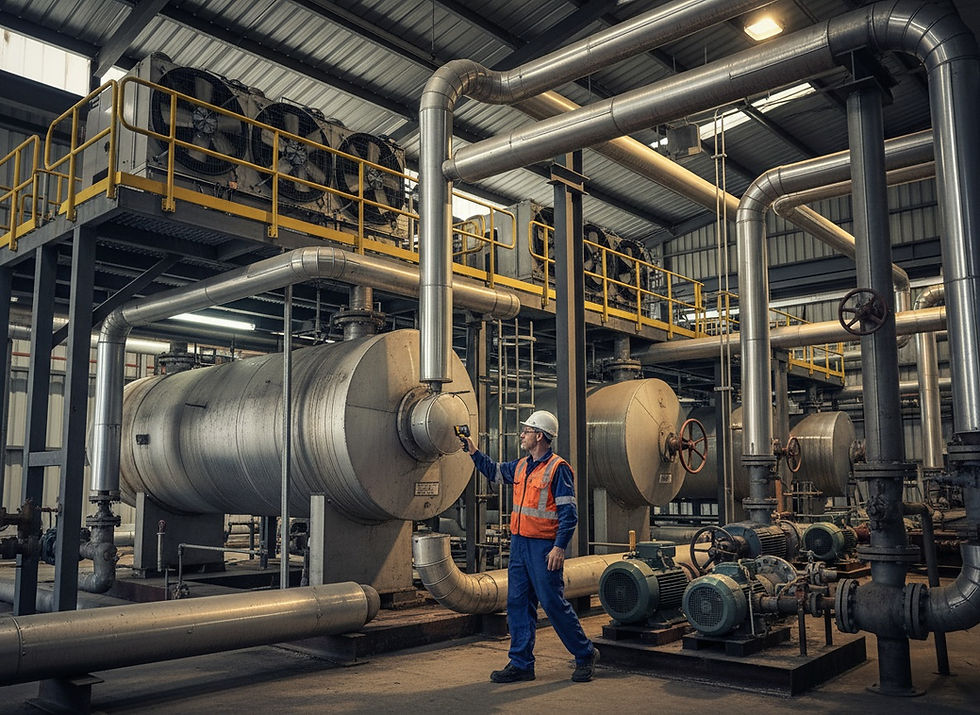
Ageing cooling systems rarely decline in one simple way. Heat-transfer surfaces can foul, fans can lose effectiveness, pumps can operate away from intended conditions, and process requirements can drift from the original design. A system may still run while gradually losing thermal margin or becoming harder to troubleshoot.
An industrial cooling network analysis helps plant teams look at the connected system rather than blaming the first underperforming component. For an ageing cooling system audit, the goal is to establish what the system is doing now, identify where constraints appear, and decide what should be inspected, cleaned, repaired, modified, or monitored next.
Establish the Current Operating Picture
Compare Present Conditions With the Intended Duty
The first step is to understand the current process duty and the duty the cooling system was intended to support. Useful inputs include fluid temperatures, flows, pressures, equipment configuration, control positions, utility conditions, and the operating mode during data collection.
Allied Heat Transfer describes its cooling systems analysis service as using diagnostic equipment to map actual operating conditions while heat exchangers and cooling systems remain in service. The website states that the collected data can be analysed using HTRI software.
That approach is relevant to industrial cooling network analysis because measured plant conditions can expose differences between the original design basis and current operation. Those differences should be understood before a maintenance or upgrade scope is chosen.
Separate Thermal Symptoms From Mechanical Symptoms
A high process outlet temperature does not automatically prove that a heat exchanger is undersized. The same symptom can occur when flow is restricted, a fan is not delivering expected airflow, fouling is present, a bypass is open, or a control problem changes the operating point.
The client website states that its analysis work can include both thermal and mechanical checking. This distinction matters because an ageing cooling system audit should not turn a thermal symptom into a mechanical repair recommendation without evidence.
Where more detailed modelling is required, thermal consultancy includes HTRI modelling, CFD modelling, CAD design, and mechanical calculations for heat-transfer equipment.
Trace Constraints Through the Network
Follow the Fluid Path, Not Just the Equipment List
Cooling networks should be reviewed as flow paths. Pumps, valves, piping, heat exchangers, coolers, towers, and return circuits can influence one another. A local restriction may change flow elsewhere, while a changed process demand may move several assets away from their previous operating conditions.
Industrial fans are one example of supporting equipment that can affect heat rejection in air-side systems. Allied Heat Transfer states that it designs, selects, assembles, and balances cooling fans for relevant applications.
The analysis should therefore ask where heat enters the network, how it is transported, where it is rejected, and what controls that path. This produces a more useful diagnosis than reviewing each asset in isolation.
Check Air-Cooled Equipment for Site-Specific Effects
Air-cooled systems depend on more than bundle surface area. Airflow, fan operation, fin condition, ambient air, obstruction, and recirculation can influence performance. Older systems can also have modified guards, ducting, fan arrangements, or surrounding structures that affect the original airflow path.
Allied Heat Transfer builds and services air cooled heat exchangers. Its consultancy and analysis pages also describe modelling and testing capabilities for air-cooled heat exchangers.
For an industrial cooling network analysis, these factors should be examined alongside process-side data. Otherwise, the investigation may focus on internal heat-transfer resistance while overlooking the air side.
Determine Whether Fouling Is the Main Cause
Use Condition Evidence Before Selecting a Cleaning Method
Fouling can reduce heat transfer and restrict flow, but cleaning should be selected after the likely deposit and equipment condition are understood. A plant should avoid using cleaning as a default response to every thermal problem.
Allied Heat Transfer offers chemical cleaning for several heat-transfer and industrial equipment types. Its website states that on-site chemical cleaning can include a pre-cleaning diagnosis and a condition report after the work.
This can fit an ageing cooling system audit when the evidence supports fouling as a contributing issue. The cleaning scope should still reflect equipment materials, deposit type, isolation requirements, and the agreed maintenance plan.
Consider Workshop Cleaning and Inspection When Access Matters
Some equipment needs more direct inspection, component access, re-gasketing, repair, or testing than an in-situ cleaning scope can provide. Plate heat exchangers are a clear example because plate condition and gasket condition may need to be assessed alongside cleanliness.
The Allied Heat Transfer plate heat exchangers page describes workshop cleaning, inspection, re-gasketing, assembly, and testing services. The page also states that ultrasonic and chemical bath immersion cleaning methods are available.
The important diagnostic point is to select the maintenance route from observed condition and equipment design, not from a generic assumption about ageing assets.
Decide What to Repair, Modify, or Retain
Use Repair Findings to Refine the System Diagnosis
An ageing system can contain equipment that is thermally adequate but mechanically degraded. It can also contain mechanically sound equipment that no longer suits the process duty. The repair decision should consider both cases.
Allied Heat Transfer's repair and maintenance service covers repair, rebuild, cleaning, re-tubing, and re-coring across heat-transfer equipment. The website also notes that design staff can assess the performance effect of changes such as blanking tubes.
That is useful when an audit finds defects that could alter the thermal calculation. A repair plan should record any change that may affect flow area, heat-transfer area, pressure drop, or future serviceability.
Review System-Level Changes Before Replacing Assets
If several constraints are linked, a component-by-component replacement strategy may create new mismatches. A revised pump, exchanger, fan, or tower can change the operating conditions seen by other equipment.
For broader system changes, Allied Heat Transfer presents complete cooling systems as integrated cooling packages developed from collected design parameters. This capability is relevant when the analysis shows that the limitation is network-wide rather than confined to one exchanger.
Allied Heat Transfer also presents design, manufacture, service, and maintenance capabilities across industrial heat-transfer systems. The appropriate scope should still be driven by the findings of the audit.
FAQs
What Is an Industrial Cooling Network Analysis?
It is an engineering review of the connected cooling system using operating conditions, equipment information, and diagnostic findings. The purpose is to identify where thermal or mechanical constraints are affecting the overall system.
What Should an Ageing Cooling System Audit Check First?
Start with current operating conditions and process duty. Then review flow paths, heat-transfer equipment, airflow or water-side conditions, control states, visible condition, and maintenance history where available.
Does Poor Cooling Performance Always Mean Fouling?
No. Fouling is one possible cause. Flow restrictions, fan issues, process changes, utility changes, controls, equipment damage, or an altered system configuration can produce similar symptoms.
Can Cooling-System Analysis Be Performed While Equipment Is Operating?
Allied Heat Transfer states that its cooling-system analysis service uses diagnostic equipment to map operating conditions while equipment remains in service. The suitability of any site activity still depends on the plant, access, safety requirements, and agreed test scope.
Conclusion
An ageing cooling system audit is most useful when it treats the plant as an interacting network. Measured operating conditions, thermal checks, mechanical findings, and equipment condition should be combined before maintenance or upgrade decisions are made.
For a site-specific review of an existing cooling network, request an initial technical discussion with Allied Heat Transfer and define which operating conditions and assets need to be assessed.


