
The Precision of Orbital Welding in Modern Shell and Tube Fabrication

Updated: Aug 19
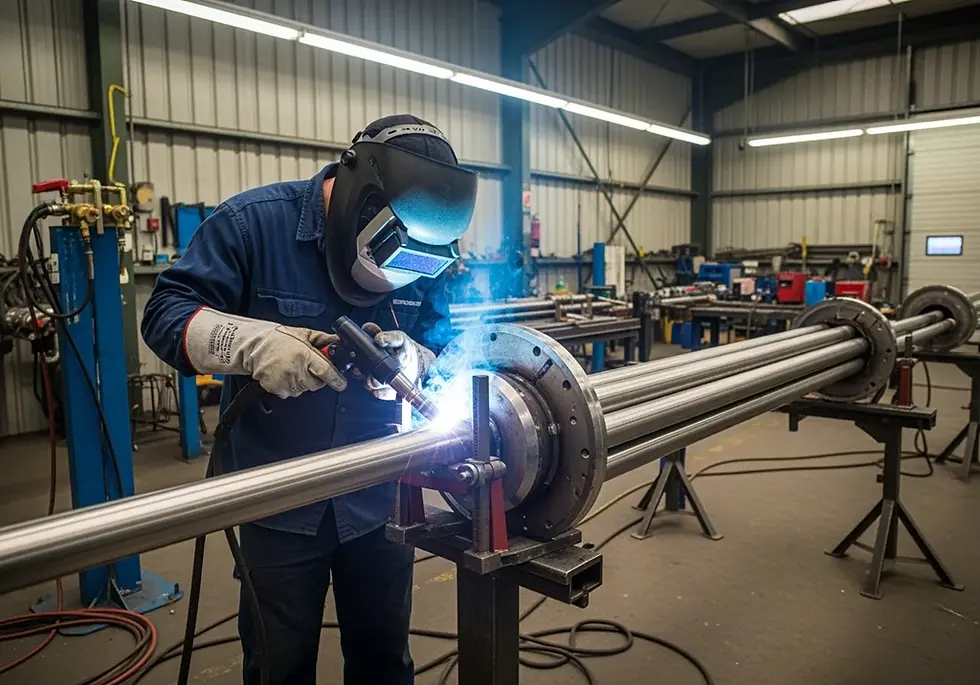
Weld consistency is one of the most critical variables in heat exchanger manufacturing. In shell and tube fabrication, tube-to-tubesheet joints must seal reliably against process fluids under pressure, withstand thermal cycling across the full operating range, and meet the strict requirements of Australian and international pressure vessel codes. When hundreds or thousands of individual tube joints are involved, manual welding introduces variability that is difficult to control and even harder to document.
Orbital welding addresses this challenge directly. The technology automates the tube-to-tubesheet welding process, removing the human variables that cause inconsistency and replacing them with precisely programmed parameters. For industrial fabrication applications where equipment must perform reliably under demanding conditions, this level of process control has significant implications for quality, certification, and long-term performance.
This article examines how orbital welding works, what it delivers in terms of tube-to-tubesheet weld quality, how it aligns with AS1210 pressure vessel certification requirements, and where it fits in repair and maintenance applications including re-tubing projects across Australian industrial operations.
What Orbital Welding Brings to Heat Exchanger Fabrication
From Manual to Automated Tube Welding
Traditional manual TIG welding requires a skilled welder to maintain consistent torch angle, travel speed, and heat input while working continuously around a tube circumference. This demands significant skill and sustained concentration, particularly over long production runs involving large tube counts. Natural variation between individual welds is unavoidable, and that variation becomes cumulative across an entire tubesheet.
Orbital welding removes this dependency on individual skill by programming weld parameters into a computer-controlled system. Each weld receives the same heat input, travel speed, and current profile as the one before it. The result is that tube one and tube one thousand receive welds of equivalent quality - a consistency that manual welding cannot reliably achieve across large industrial fabrication runs.
The Mechanics of Orbital Welding Systems
An orbital welding system uses a rotating tungsten electrode that travels in a continuous circular path around a fixed tube. The welding head clamps onto the tube and creates a sealed environment with inert gas shielding, typically argon or helium. A computer-controlled power supply regulates current, voltage, and rotation speed throughout the weld cycle.
Modern systems include closed-loop arc voltage control that adjusts power output in real time to compensate for variations in tube-to-tubesheet fit-up. This adaptive control maintains consistent penetration even when manufacturing tolerances create slight gaps or misalignments between components - a practical advantage in high-volume industrial fabrication environments where perfect fit-up across every joint is difficult to guarantee.
Weld Quality Advantages in Shell and Tube Manufacturing
Penetration Consistency and Heat-Affected Zone Control
Penetration depth is critical in tube-to-tubesheet joints. These welds must seal against process fluids under pressure while withstanding thermal cycling during startup, shutdown, and load changes. Insufficient penetration creates leak paths that compromise pressure containment. Excessive penetration can restrict tube bore diameter and reduce heat transfer efficiency over time.
Orbital welding maintains penetration depth within tight tolerances across all joints in a tubesheet. This level of consistency is the foundation of reliable tube-to-tubesheet weld quality in demanding heat exchanger manufacturing applications.
Heat-affected zone control is equally important, particularly for stainless steel alloys. Duplex and super-duplex grades require careful thermal management to avoid sensitisation or phase imbalance that degrades corrosion resistance. Orbital welding's precise heat input minimises the heat-affected zone width while ensuring complete fusion. This becomes essential when working with exotic alloys such as Monel 400, Inconel 625, or titanium, where excessive heat degrades the material properties that justify the specification in the first place.
Root Pass Quality and Long-Term Joint Integrity
Root pass quality determines long-term joint integrity more than any other single factor. Manual welding from the tube side creates risk of incomplete root fusion. Orbital systems weld from the tubesheet face, producing clean root beads with full penetration into the tube wall. This approach eliminates the crevice corrosion risk associated with incomplete root fusion - a failure mode that often only becomes apparent months or years after installation.
Shell and tube heat exchangers built with orbital welding benefit from this root pass consistency across every joint, whether the tube count is fifty or three thousand.
Material Compatibility and Welding Parameters
Standard Austenitic and Duplex Stainless Grades
Different tube materials require specific orbital welding programs. The welding controller stores these parameters as selectable programs that operators choose based on material specification. Carbon steel tubes use different amperage and travel speed settings compared to austenitic stainless steels. The appropriate program is selected before welding begins, ensuring each material receives the correct thermal treatment.
Austenitic stainless steels such as 304 and 316 weld readily with orbital systems using argon shielding. These materials tolerate broader parameter windows, making them well-suited to high-volume industrial fabrication where consistent results are needed across large tube counts.
Duplex and super-duplex grades such as 2205 and 2507 require nitrogen-enriched shielding gas to maintain proper phase balance between ferrite and austenite. Orbital welding is particularly well-suited to these materials because consistent heat input prevents excessive ferrite formation that reduces corrosion resistance. Systems can integrate temperature sensors that pause welding if the tubesheet exceeds specified interpass temperature limits, providing a level of process control that manual welding cannot reliably replicate.
Nickel Alloys and Titanium Welding Requirements
Nickel alloys including Monel, Inconel, and Hastelloy require precise heat control to avoid hot cracking. Orbital welding's repeatable thermal cycles reduce crack susceptibility compared to manual processes. These materials typically require pulsed current programs that alternate between peak and background amperage, controlling total heat input while maintaining stable arc characteristics.
Titanium presents unique challenges due to its reactivity with oxygen at welding temperatures. Orbital systems use trailing shields and purge gas backing to protect the weld zone during cooling. Maintaining this level of atmospheric protection manually is difficult and inconsistent, making orbital welding the practical standard for titanium tube-to-tubesheet joints in industrial fabrication projects.
Meeting AS1210 and NATA Testing Requirements
Documentation and Quality Management Systems
Pressure vessel certification under AS1210 pressure vessel certification requirements demands documented evidence of weld quality. Each orbital weld program generates a data log recording actual current, voltage, and rotation speed throughout the weld cycle. These logs provide objective evidence of process control for quality management systems certified to ISO 9001 or applicable DNV standards.
Allied Heat Transfer integrates orbital welding into its heat exchanger manufacturing processes, with fabrication certified to AS1210 and ASME Section VIII pressure vessel codes. This documentation capability means inspectors can verify that each weld received specified parameters without relying solely on visual assessment.
Inspectors reviewing orbital weld logs can confirm parameter compliance across every joint in a tubesheet, providing a level of quality assurance that supports both regulatory requirements and customer acceptance testing.
Inspection Methods and Rejection Rate Reduction
Visual inspection is more straightforward with orbital welds. The uniform bead profile and consistent ripple pattern allow inspectors to identify anomalies quickly. Manual welds exhibit natural variation that complicates defect detection, as distinguishing between acceptable variation and actual defects requires experienced judgement and can produce inconsistent results between inspectors.
Liquid penetrant testing detects surface-breaking defects such as cracks or incomplete fusion. Orbital welding's controlled heat input and consistent cooling rates reduce residual stress that causes cracking. Manufacturers transitioning from manual to orbital tube welding typically observe lower rejection rates during penetrant testing examinations.
Destructive testing involves sectioning sample welds to verify penetration depth and fusion quality. AS1210 requires this testing for initial procedure qualification and periodic revalidation. Orbital welding produces consistent enough results that sample testing reliably represents production weld quality - a critical advantage when building heat exchangers with large numbers of tube joints where statistical sampling must adequately represent the population.
Productivity and Manufacturing Throughput
Welding Speed and Labour Considerations
Orbital systems complete tube welds at a substantially higher rate than manual welding, with a single operator capable of managing multiple welding heads. For large shell and tube units with significant tube counts, this productivity difference has a direct impact on manufacturing lead times and workshop capacity utilisation.
Labour cost considerations extend beyond welding speed. Manual tube welding requires certified pressure vessel welders with years of training and experience. Orbital welding operators need less extensive certification because the automated system controls the critical parameters. This broadens the available labour pool and reduces the sensitivity of manufacturing capacity to skilled welder availability - a practical consideration given the ongoing demand for qualified welding trades across Australian industrial fabrication.
Turnkey cooling systems that incorporate large shell and tube heat exchangers benefit directly from the throughput advantages of orbital welding, supporting shorter delivery timeframes for complete integrated cooling packages.
Setup Time and Multi-Head Systems
Setup time is the primary productivity challenge with orbital welding. Each tube requires the welding head to be positioned, clamped, and verified before the weld cycle begins. Modern quick-change collets and magnetic tubesheet clamps reduce this setup time per tube significantly for heat exchangers with uniform tube sizes.
Multi-head systems multiply productivity gains further. A single operator can manage several orbital welding heads simultaneously, starting a weld on one tube while others complete their cycles. This approach is particularly effective for large tube counts where the operator moves between heads in a continuous rotation pattern.
Fit-up requirements become more critical with orbital welding than with manual techniques. The automated process cannot compensate for excessive gaps between tube and tubesheet - gaps beyond tolerance limits typically cause incomplete fusion or burn-through. Tight machining tolerances on tubesheet hole diameters and tube outside diameters are therefore a prerequisite for achieving the weld quality advantages that orbital systems offer. This adds some machining cost to fabrication but is essential to realising the quality benefits that justify the technology investment.
Repair, Maintenance, and Re-tubing Applications
Re-tubing with Orbital Welding Consistency
Orbital welding extends beyond new fabrication into repair and maintenance operations. Heat exchangers requiring tube replacement benefit from orbital welding's consistency when installing new tubes into existing tubesheets. The automated process eliminates the risk of damaging adjacent tubes with excessive heat input during repair welding - a common problem with manual repair work in densely packed tube layouts.
Repair and maintenance operations involving re-tubing produce joints matching original fabrication quality without requiring the highly specialised welding skills needed for manual repair work in confined tubesheet environments. This capability is particularly valuable for remote mine sites and offshore facilities where access to certified pressure vessel welders can be limited.
Partial Re-tube and Code Compliance
Partial re-tubing addresses localised corrosion or erosion damage without requiring complete heat exchanger replacement. Orbital welding ensures new tube joints meet pressure vessel code requirements for strength and leak-tightness. The documented weld parameters satisfy regulatory requirements for pressure equipment modifications under Australian standards, supporting compliance with pressure vessel inspections and statutory obligations.
Heat exchanger manufacturing Australia-wide increasingly specifies orbital welding for new fabrication and re-tube projects where pressure vessel code compliance and long-term reliability are non-negotiable requirements.
Shell and tube fabrication standards for orbital welding require tight machining tolerances on tubesheet hole diameters and tube outside diameters. The automated process cannot compensate for excessive gaps between tube and tubesheet - gaps exceeding the tolerance limit typically cause incomplete fusion or burn-through. Maintaining these machining tolerances adds cost to fabrication but delivers superior weld quality that justifies the investment.
For maintenance managers evaluating re-tube contractors, orbital welding capability in a fabricator's workshop is a meaningful indicator of quality commitment. A workshop that invests in orbital welding technology, operator training, and the precision machining required to support it is demonstrating a systematic approach to weld quality - one that is reflected in the consistency of finished joints and the reliability of documentation provided with completed equipment.
Conclusion
Orbital welding transforms shell and tube heat exchanger fabrication from a skill-dependent manual process into a controlled, repeatable manufacturing operation. The technology delivers consistent tube-to-tubesheet weld quality across large tube counts, meeting the requirements of AS1210 pressure vessel certification and ASME Section VIII while improving productivity and reducing rejection rates.
For engineers specifying heat exchangers or maintenance managers evaluating re-tube projects, orbital welding capability in a fabricator's workshop indicates a genuine commitment to quality and process control. The consistency it delivers across industrial fabrication projects underpins the long-term reliability of equipment operating in demanding Australian industrial applications.
For expert advice on heat exchanger specification or re-tubing requirements, reach out to our industrial cooling engineers or call us on (08) 6150 5928.


