
Industrial Fan Blade Materials: Aluminium vs FRP for Australian Conditions

Updated: Aug 19
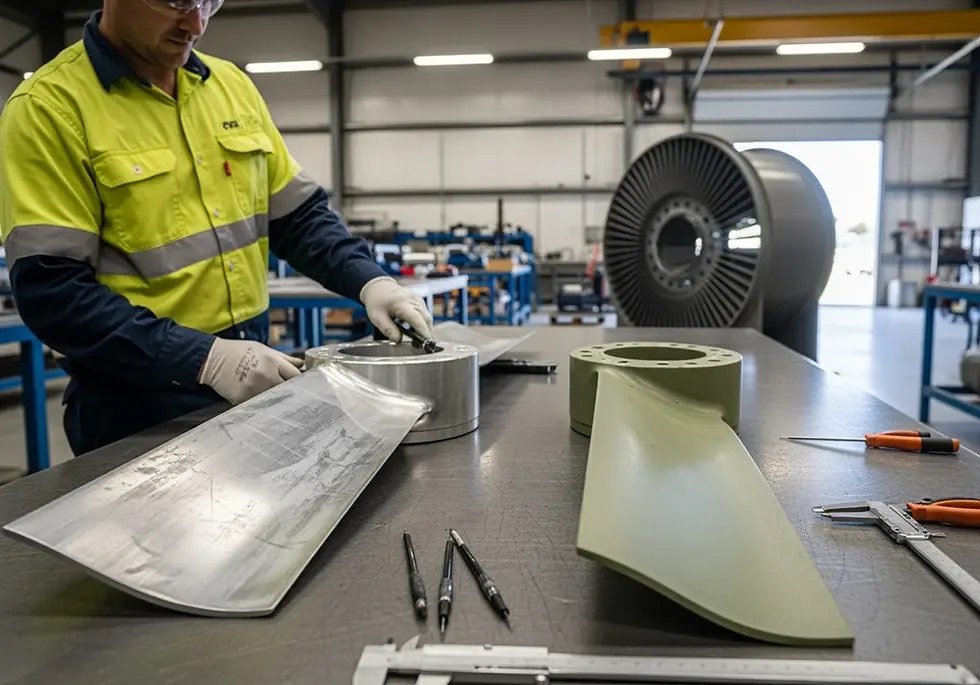
Selecting the right industrial fan blade material determines whether your cooling system survives or fails in Australian industrial environments. The choice between aluminium fan blades and fibre-reinforced plastic (FRP) affects durability, maintenance requirements, and operational reliability across mining, manufacturing, and heavy industry applications.
Australian conditions test industrial cooling equipment beyond typical design parameters. Temperatures swing from well below zero on winter mornings to 50°C summer peaks in parts of the Pilbara. Dust loads in mining operations can be extreme. Corrosive coastal environments attack unprotected metal surfaces within months. These factors make industrial fan blade materials a critical engineering decision, not an afterthought.
This guide compares aluminium fan blades and FRP alternatives across the parameters that matter most to engineers and plant operators specifying cooling equipment for Australian conditions.
Aluminium Fan Blade Properties
Aluminium alloys are widely used in industrial fan applications for well-established technical reasons. Understanding both their strengths and limitations is essential for correct cooling fan blade selection.
Mechanical Performance
Aluminium 6061-T6 is the standard alloy for aluminium fan blades in industrial service. It provides good tensile strength with sufficient elongation to handle the centrifugal forces and vibration loads encountered in forced draft cooling applications. The material maintains structural integrity through temperature cycling without brittle fracture under normal service conditions.
Fatigue resistance at appropriate stress levels supports long service life in constant-speed applications. Variable frequency drive (VFD) installations require additional fatigue analysis. Speed variations create variable stress amplitudes, and resonance at specific operating frequencies can accelerate fatigue damage if not accounted for in the design.
Corrosion Behaviour
Bare aluminium forms a protective oxide layer within hours of atmospheric exposure. This passive film provides moderate corrosion resistance in neutral pH environments and suits general industrial atmospheres with limited chemical exposure.
Coastal installations face accelerated corrosion from chloride ions. Uncoated aluminium develops pitting corrosion with prolonged salt spray exposure. Anodising or powder coating extends service life significantly but requires inspection at regular intervals and maintenance when coating damage occurs.
Mining environments with acidic process gases at low pH cause rapid aluminium degradation. Sulphuric acid mist from ore processing attacks the oxide layer, leading to intergranular corrosion. These applications generally require protective coatings or a change to an alternative material.
FRP Fan Blade Properties
Fibre-reinforced plastic blades combine glass fibres with polyester, vinyl ester, or epoxy resin matrices. The composite structure delivers properties that no single-material design can match across chemical resistance, weight, and corrosion performance.
Composite Construction and Weight
Typical FRP fan blades use E-glass fibres in a vinyl ester resin matrix. Fibre content by weight determines the final mechanical properties. The resulting composite produces blades meaningfully lighter than equivalent aluminium designs. This weight reduction decreases bearing loads and reduces motor power requirements - a practical benefit for installations with multiple fans or remote sites where reducing energy consumption is a priority.
Industrial cooling fans using FRP blades achieve lower running loads, which can translate to smaller motor selections and extended bearing service intervals compared to equivalent aluminium blade configurations.
Chemical Resistance and Temperature Limits
Vinyl ester FRP resists most acids, alkalis, and organic solvents without measurable degradation. This broad chemical resistance makes it suitable for applications where aluminium fails rapidly. Mining operations with acid mist, chemical processing plants, and wastewater treatment facilities benefit from FRP's inert properties in aggressive chemical environments.
Chloride exposure causes no measurable degradation in properly formulated FRP blades. Extended salt spray testing shows no strength loss or surface deterioration in standard vinyl ester construction. This durability eliminates the coating maintenance required for aluminium in coastal installations.
Temperature limitations apply to FRP. Standard polyester FRP loses structural integrity above approximately 80°C continuous operation. Vinyl ester formulations extend this limit to around 95°C. Epoxy matrices offer higher temperature ratings for short durations. Applications above these thresholds require aluminium blades or appropriate high-temperature composite formulations. FRP maintains good impact resistance at low temperatures, making it suitable for refrigeration and cold-climate applications where aluminium becomes increasingly brittle.
Durability in Australian Mining Environments
Mining operations subject cooling equipment to conditions that accelerate material degradation. Dust abrasion, chemical exposure, and thermal cycling test both aluminium and FRP blade designs in ways that controlled testing cannot fully replicate. Aluminium fan blade mining performance depends heavily on protective coating condition, whilst FRP fan blade corrosion resistance holds up without coatings across most mining atmospheres.
Abrasive Wear Resistance
Silica dust in mining air has a Mohs hardness significantly higher than both aluminium and FRP matrix materials. Particle impacts at blade tip speeds cause progressive material removal. Standardised dust testing shows that FRP blades lose less thickness per operating hour than aluminium blades under identical dust concentration conditions. The composite structure of FRP contributes to this result - abraded fibres partially shield underlying material from further particle impact.
Leading edge erosion affects both materials but progresses differently. Aluminium develops smooth wear patterns that maintain aerodynamic efficiency until structural thickness becomes critical. FRP shows surface roughening that increases drag before structural integrity is compromised. For highly abrasive applications, polyurethane edge protection strips on FRP blades can slow leading edge erosion considerably.
Vibration and Fatigue
Mining equipment vibration transmits through mounting structures into fan assemblies. Continuous vibration excites blade resonance modes, causing fatigue stress cycles that can lead to premature failure if not addressed in the design.
Aluminium's higher elastic modulus produces stiffer blades with higher natural frequencies. This stiffness helps avoid resonance in many applications but requires careful VFD programming to skip critical frequencies during speed ramp-up. Aluminium fan blade mining installations must account for this resonance risk when VFD control is used. FRP blades with lower modulus exhibit lower natural frequencies but provide more inherent damping that reduces peak stress amplitudes. Both materials require proper blade mounting and vibration isolation to prevent fatigue failures in high-vibration environments.
Performance in Coastal and Corrosive Environments
Australian coastal industrial sites combine high humidity, salt spray, and elevated temperatures. Air cooled heat exchangers in these environments require fan blades that will not corrode through standard maintenance intervals.
Salt Spray Performance
Accelerated corrosion testing per ASTM B117 quantifies material performance in marine atmospheres. Uncoated aluminium develops measurable pitting after extended salt spray exposure. The service life without protective coatings is limited in direct coastal exposure. Powder-coated aluminium extends service life considerably when the coating remains intact. Impact damage, thermal cycling, and flexural stress can cause coating cracks that initiate localised corrosion. Regular inspection and touch-up maintains protection between full recoating cycles.
FRP blades show no measurable degradation after extended salt spray testing. The non-metallic construction eliminates galvanic corrosion concerns when mounted on stainless steel or coated carbon steel hubs. This durability makes FRP particularly suited to cooling towers and other equipment in coastal mining operations.
Chemical Process Environments
Mineral processing, chemical manufacturing, and wastewater treatment expose cooling fans to corrosive gases and mists. Aluminium's reactivity with acids and strong alkalis limits its application in these environments without extensive protective measures that require ongoing maintenance.
FRP handles most process chemical environments without special coatings. Vinyl ester resin resists sulphuric acid, hydrochloric acid, and sodium hydroxide solutions across common industrial concentration ranges. This chemical resistance eliminates the inspection and maintenance burden associated with coated metal blades in aggressive process atmospheres.
Temperature limitations constrain FRP use in high-temperature process cooling. Applications above approximately 95°C continuous operation require aluminium blades with appropriate corrosion-resistant coatings or stainless steel construction. In applications combining chemical resistance requirements with higher temperatures, the fan blade material selection must be evaluated alongside the heat exchanger type - plate heat exchangers in chemical service often pair with FRP fan blades where temperatures remain within the FRP operating range.
Weight and Motor Power Considerations
Blade weight directly affects motor selection, bearing service life, and energy consumption. The weight advantage of FRP over aluminium produces operational benefits that compound over the service life of the equipment.
Motor Sizing and Bearing Load Impact
The weight reduction of FRP blades compared to equivalent aluminium blades decreases starting torque requirements and reduces radial bearing loads proportionally. Extended bearing service intervals result from this reduced load, lowering maintenance costs and reducing unplanned downtime over the equipment's service life.
Dynamic balancing requirements ease with lighter blades. FRP fans typically achieve acceptable balance grade with standard balancing procedures. Aluminium fans sometimes require additional balancing iterations to reach equivalent vibration levels, particularly after manufacture or repair.
Lifecycle Cost Analysis
Industrial fan blade material selection requires balancing upfront costs against long-term operational expenses. Australian conditions often favour higher initial investment where it delivers reduced maintenance burden and extended service intervals.
Purchase Price and Maintenance Costs
FRP blades carry a higher purchase cost than aluminium blades of equivalent size. The premium reflects manufacturing labour and lower production volumes compared to cast aluminium. However, evaluating fan blade lifecycle cost Australia-wide shows that in coastal and corrosive environments, FRP blades require only periodic visual inspection for impact damage or mounting hardware condition. Aluminium blades in identical environments require regular coating inspections, touch-up painting, and periodic full recoating. These maintenance costs accumulate significantly over a ten to fifteen year service period.
Replacement Frequency and Total Cost of Ownership
Replacement frequency affects the total cost of ownership calculation. Aluminium blades in harsh mining environments typically reach replacement condition earlier than FRP blades in equivalent service. The extended service interval of FRP in corrosive environments often offsets the higher purchase cost when evaluated over the full equipment lifecycle. Fan blade lifecycle cost Australia assessments should include coating maintenance labour, recoating materials, and replacement frequency - not just purchase price alone. Where FRP fan blade corrosion resistance eliminates coating cycles entirely, the total expenditure over fifteen years often favours FRP despite the higher upfront cost. Cooling systems analysis can help quantify this comparison for specific site conditions.
Application-Specific Recommendations
Neither material suits all applications. Correct cooling fan blade selection depends on operating conditions, maintenance capabilities, and project budget constraints.
When to Choose Aluminium
Temperature requirements above the FRP operating limit require aluminium. High-temperature process cooling and exhaust applications need aluminium's thermal stability. Properly selected alloys and protective coatings extend service life in demanding conditions.
Impact resistance may favour aluminium in applications with potential foreign object damage. Aluminium withstands mechanical impacts with more predictable failure modes than FRP in some configurations. Mobile equipment cooling and areas with difficult maintenance access benefit from aluminium's damage tolerance.
Budget-constrained projects with established coating maintenance programmes may achieve satisfactory lifecycle performance with aluminium at lower initial cost, provided corrosion inspection and coating maintenance are reliably performed.
When to Choose FRP
Corrosive environments are the clearest case for FRP. Chemical processing, coastal installations, and mining operations with acidic process gases justify the premium cost through eliminated coating maintenance and extended service life.
Energy efficiency goals benefit from FRP's weight advantage, which reduces motor power requirements and running loads. Remote installations and confined spaces with difficult access benefit from FRP's minimal maintenance requirements.
Allied Heat Transfer supplies air cooled heat exchangers and industrial cooling systems with material configurations appropriate to each application. Fan blade material selection is part of the equipment specification process, taking into account site conditions and maintenance capabilities.
Australian Standards and Design Requirements
Fan blade selection must satisfy relevant Australian Standards for mechanical equipment and air handling systems.
Structural Design Requirements
Both aluminium and FRP blades require engineering calculations per AS 1170.2 for wind loads on exposed installations. Centrifugal stress analysis must confirm blade integrity at maximum operating speed with an appropriate overspeed margin.
Fatigue analysis applies to continuously operating fans. The design must demonstrate adequate cycle endurance at operating stress levels. This analysis is critical for VFD installations where speed variations create variable stress amplitudes.
Safety Factor Application
Aluminium blade designs typically use conservative safety factors on ultimate tensile strength to account for corrosion allowance and fatigue strength reduction over service life. FRP designs require higher safety factors due to material property variability associated with hand lay-up manufacturing. Higher safety factors compensate for potential resin-rich areas or fibre misalignment that can occur during production.
The repair and maintenance of fan blades after damage should always be assessed against the original design safety factors to ensure the repaired component remains fit for continued service.
Conclusion
Industrial fan blade material selection significantly influences cooling system reliability and lifecycle costs in Australian conditions. Aluminium delivers good mechanical performance at lower initial cost but requires ongoing corrosion protection in harsh environments. FRP eliminates coating maintenance and reduces running loads whilst requiring higher capital investment.
Mining operations with corrosive atmospheres and coastal installations benefit from FRP's chemical resistance and durability. Manufacturing facilities with controlled environments and established maintenance programmes can achieve satisfactory results with properly coated aluminium. For guidance on fan blade materials suited to a specific application, contact our heat exchanger specialists to discuss operating conditions and performance requirements.


